
Any exterior sign visible from a public street in McKinney needs a sign permit before it goes up, and the process trips up more business owners than most expect. Between site plans, structural requirements, and the city’s review queue, a sign permit in McKinney, TX involves more steps than a simple form. This overview walks through what the City of McKinney requires, how long approval typically takes, what triggers a variance, and the mistakes that push a straightforward project back by weeks.
Why McKinney Requires a Sign Permit Before Installation
McKinney’s Unified Development Code (UDC) sets specific standards for sign size, height, illumination, and placement, and the city’s Development Services Department checks every application against those standards before anything goes up. The goal isn’t just paperwork. Sign placement affects sightlines at intersections, driveway visibility, and the overall look of a commercial corridor, so the review exists to keep signage safe and consistent with the surrounding area.
Sign permit: a document issued by the City of McKinney’s Development Services Department authorizing the fabrication, installation, or structural alteration of a sign visible from the public right-of-way.
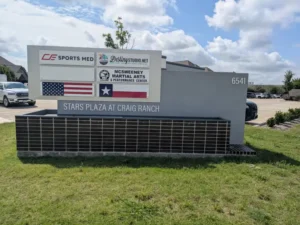
Monument signs, wall signs, channel letters, pylon signs, and awning signs with lettering all typically require a permit. Small interior window graphics and short-duration temporary banners are sometimes exempt, but the size and time thresholds are specific enough that it’s worth confirming with the city rather than assuming an exemption applies.
What Information the City of McKinney Requires in a Sign Permit Application
A complete application does more than list the sign type. Reviewers need enough detail to confirm the sign meets code on the first pass, which is the fastest way through the queue. In our experience handling permit submissions across North Texas, the applications that move quickest include:
- A scaled site plan showing the sign’s location relative to property lines, easements, and the public right-of-way
- Sign elevation drawings with exact dimensions, materials, and colors
- Structural and wind-load engineering details for any freestanding sign (monument or pylon)
- An electrical permit and load calculations if the sign is illuminated or wired to power
- Written authorization from the property owner if the applicant is a tenant, not the owner
- Proof that the installing contractor is registered with the City of McKinney
Missing any one of these is the single most common reason an application gets kicked back for revisions instead of moving straight to approval.
Typical Review and Approval Timelines
For a standard wall or monument sign that meets code without any variance, initial review in McKinney generally runs two to three weeks. Signs that require a structural stamp, an electrical sub-permit, or fall inside an overlay district with added design standards tend to run longer, often four to eight weeks once revisions and re-review are factored in. These are general ranges, not guarantees. Queue volume shifts by season, so confirming current turnaround directly with the city’s Development Services Department before finalizing a project timeline is always the safer move.
Business owners planning a grand opening or a rebrand around a specific date should build in a buffer. A permit that gets kicked back once for a missing drawing can easily add two to three weeks to a project that otherwise would have cleared review on the first submission.
What Triggers a Sign Variance Request in McKinney
Most signs that meet the UDC’s standard size, height, and placement rules move through as a standard permit. A variance becomes necessary when the proposed sign falls outside those limits and the applicant is asking the city to make an exception. Common triggers include:
- A sign larger than the maximum allowable square footage for the zoning district
- A pole or pylon sign taller than the district’s height limit
- Properties inside an overlay district with stricter historic or corridor design standards
- Multi-tenant properties requesting more signs than the code allows per building or per tenant
- Illuminated signage proposed near or adjacent to residential zoning
A variance request goes to the Board of Adjustment, which requires public notice and a hearing before a decision. That process adds real time to a project, so it’s worth confirming early whether a design will need one, rather than discovering it after drawings are already finalized.
Common Mistakes That Delay Sign Permit Approval
Most permit delays in McKinney trace back to the same handful of errors, and nearly all of them are avoidable with the right preparation up front.
Submitting a Floor Plan Instead of a Scaled Site Plan
Reviewers need to see the sign’s exact location relative to property lines and the right-of-way. An interior floor plan or a rough sketch doesn’t satisfy that requirement and gets sent back every time.
Missing Structural Engineering for Freestanding Signs
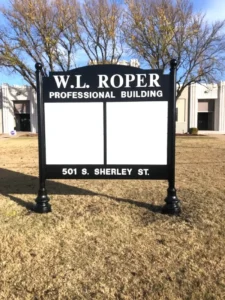
Monument and pylon signs need a stamped structural calculation showing they can handle North Texas wind loads. Applications that skip this step stall until an engineer is brought in, which can add weeks if it wasn’t planned for from the start.
Overlooking Landlord or Shopping Center Sign Criteria
Many shopping centers and business parks have their own sign criteria on top of the city’s requirements, covering size, color, and placement within the tenant’s storefront. A design that clears city review can still get rejected by a landlord if this step gets skipped.
Working With a Contractor Unfamiliar With McKinney’s Process
A general contractor without sign-specific permit experience often underestimates the documentation McKinney requires, which shows up as repeated rounds of revisions rather than a clean approval.
Working With a Sign Company That Knows McKinney’s Permit Process
Vantage Point Signs works across North Texas and the DFW market, and permit paperwork is part of nearly every exterior sign project we take on. We prepare the site plans, elevation drawings, and structural documentation the City of McKinney expects, and we manage the back-and-forth with reviewers so a business owner isn’t the one chasing down a missing form. That groundwork is often the difference between a permit that clears in three weeks and one that stretches into months.
If an exterior sign is part of an upcoming project, our exterior signs page covers the sign types, materials, and installation process we handle for McKinney and North Texas businesses from design through permit approval.
Frequently Asked Questions About Sign Permits in McKinney, TX
How long does it take to get a sign permit in McKinney, TX?
Standard signs without a variance typically clear initial review in two to three weeks in McKinney. Signs requiring structural engineering, an electrical sub-permit, or a variance often take four to eight weeks or more, so it’s worth confirming current timelines with the city before locking in a project date.
Do I need a permit for a temporary banner or window sign in McKinney?
Some small window graphics and short-duration temporary banners are exempt under McKinney’s sign code, but the size and time limits are specific. Confirming exemption status with the city before installing is safer than assuming a sign qualifies.
What happens if I install a sign in McKinney without a permit?
An unpermitted sign in McKinney can result in code enforcement action, fines, or an order requiring removal of the sign. Getting the permit before fabrication and installation avoids that risk entirely.
What is a sign variance and when do I need one?
A sign variance is a request to exceed the city’s standard sign size, height, or placement rules, and it requires a Board of Adjustment hearing. A variance is typically needed when a sign design exceeds the square footage or height allowed in a given zoning district.
Who submits the sign permit application, the property owner or the tenant?
Either can submit, but a tenant applying for a sign permit needs written authorization from the property owner regardless of who files the paperwork. Many commercial sign companies handle this submission on behalf of the business.