
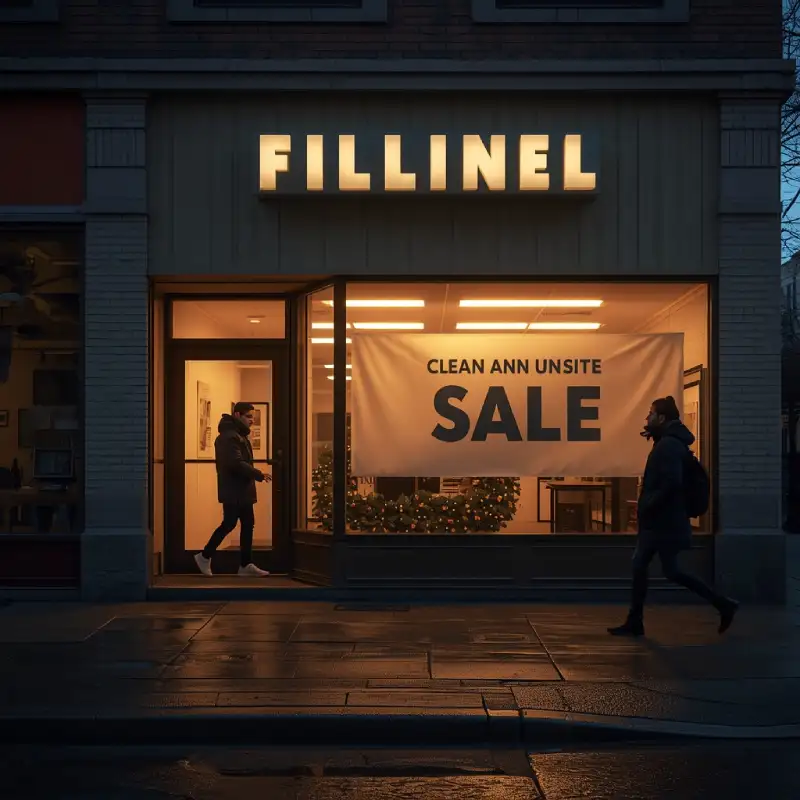
Retailers plan holiday inventory in summer and holiday signage in November, which is exactly backward. Retail exterior signs drive holiday foot traffic in three distance zones: road visibility that pulls drivers into the lot, sidewalk level signage that converts passers by, and doorway signage that closes the decision. A plan covering only one zone leaves traffic on the table, and the pieces that need a permit take longest to get.
The stores that get this right treat September and October as the build window and November as the promotion window. Here is how to structure that.
Work Backward From Black Friday, Not Forward From Today
The single most common failure we see is a retailer calling in early November for a lit sign. Fabrication is not the bottleneck. Permitting and installation scheduling are, and both compress badly once every other business in the county wants the same weeks.
| When | What to Do | Why This Window |
|---|---|---|
| Late August to September | Site walk, decide sign types by zone, start permit applications for permanent or illuminated signage | Permit review is the longest and least predictable step |
| September to early October | Design approval and fabrication of permanent signage; order temporary banners and A-frames | Fabrication and print schedules are still open |
| October | Install permanent signage; night walk of the property to check illumination and dark spots | Fixes are still possible before the season starts |
| Early November | Hang banners, flags, and seasonal window graphics; confirm holiday hours signage | Promotion goes live before Black Friday traffic builds |
| Black Friday to December | Nothing structural. Swap window messaging only | Install crews and permit desks are backed up |
| Early January | Remove temporary signage; note what worked for next year | Stale holiday signage reads as neglect |
Temporary formats can move faster than that, but permanent signage on a facade or a pole cannot. If it attaches to the building or the ground, assume the city is part of your timeline.
Match the Sign to the Distance It Has to Work At
This is where most holiday signage budgets get misspent. A retailer buys three window clings and wonders why traffic did not move. Window graphics work at five feet, and the shopper who never turned into the lot never got within five hundred.
The Road Zone: 100 Feet and Beyond
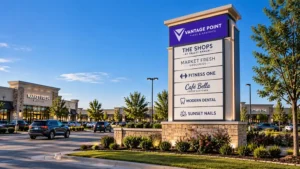
At driving speed a shopper reads one idea. Your job here is identification, not persuasion, so this zone is about brand recognition and legibility: pylon signs [/pylon-signs/] at the road, monument signs at the entrance [/monument-signs/], and building letters high on the facade. Holiday-specific messaging is usually wasted at this distance because there is no time to read it. What matters is that the store is visible and identifiable at dusk and in rain, which is a lighting and contrast question rather than a seasonal one.
The Sidewalk Zone: 20 to 50 Feet
This is where the promotion lives. Banners across the storefront, A-frames at the walkway, feather flags at the lot entrance, and post and panel signage [/post-panel-signs/] carrying an offer all belong here. The shopper is already parked or walking, moving slowly enough to read a short message, and still deciding between your door and the one next to it. Keep it to six words or fewer and one clear benefit. Holiday hours, a gift card offer, or a specific promotion outperforms generic seasonal decoration in this zone every time.
The Door Zone: 5 Feet
At the threshold, signage answers logistics. Extended holiday hours, curbside pickup instructions, return policy through January, gift wrapping availability. Window and door graphics carry this well, and seasonal window graphics can be swapped without touching the permanent storefront identity. This is the cheapest zone to update and the one retailers most often leave stale into December.
What Should Be Permanent and What Should Be Temporary
Treat the split as a question about who the sign is for. Signage that identifies the business is permanent infrastructure: facade letters, pylon and monument signs, illuminated cabinets. Buy those once, buy them well, and stop redoing them.
Signage that carries a message with an expiration date should be temporary and easy to remove: banners, A-frames, feather flags, window promotions. The mistake runs in both directions. Retailers hang a vinyl banner as a permanent storefront sign, where it fades and reads as low rent by February, or they order a costly permitted panel for a six-week promotion. If the message will change, buy a format designed to change.
In December, Your Best Selling Hours Are Dark Hours
Shorter days change what an exterior sign can do. Evening shopping traffic through December happens after dark, which means unlit signage stops working during a meaningful share of your open hours while your lit competitor stays visible.
You do not always need a new sign to fix it. Adding gooseneck or flood lighting to an existing facade sign, checking that every lamp and LED module in a cabinet actually works before the season, and making sure lot lighting does not leave your monument sign in a dark pocket are all faster and cheaper than new fabrication. Walk your property after sunset in October. Most retailers have never seen their storefront the way a December shopper does.
Permits Do Not Pause for the Holidays
Texas cities regulate exterior signage by type, size, height, and illumination, and many also regulate temporary signage, including how long a banner may stay up and how many you may display at once. Rules differ between McKinney, Plano, Frisco, and Van Alstyne, so a plan that cleared one location does not automatically clear the next.
The risk is concentrated in the worst possible window. A sign flagged in December can be ordered down during the busiest retail weeks of the year, and enforcement does not care that the promotion ends January 2. We covered the consequences in detail in our post on unpermitted signs in Texas. Multi-location retailers should also settle the design once and roll it out consistently, which is the same discipline that keeps franchise signage on brand across locations.
Four Mistakes That Cost Retailers Traffic
Too many words. A driver reads about six words. A sidewalk shopper reads a few more. Every extra word on an exterior sign lowers the odds any of it gets read.
Decoration instead of a reason. Snowflakes and garland do not tell a shopper why to stop. An offer, extended hours, or a specific product does.
Starting in November. By then, permits, install crews, and print schedules are all backed up, and you take whatever is available.
Leaving it up too long. A holiday banner still hanging in February tells shoppers nobody is paying attention. Put the takedown date in the same calendar entry as the install.
Frequently Asked Questions About Retail Exterior Signs for the Holiday Season
When should retailers order holiday exterior signs?
Start in September for anything permanent or permitted, and by mid October for temporary formats like banners and A-frames. Permit review and installation scheduling, not printing, are what run out of time. Retailers who call in November are usually limited to whatever can be produced and installed without a permit.
Do temporary holiday signs need a permit in Texas?
Often yes. Many Texas cities regulate temporary signage, including banners, and set limits on size, placement, display duration, and how many a business may show at once. Requirements vary by city, so confirm the rules for your specific location before printing anything.
What kind of exterior sign brings in the most foot traffic?
No single sign type does it alone. Road-level signage such as pylon and monument signs makes shoppers aware the store exists, sidewalk-level banners and A-frames carry the offer that turns awareness into a stop, and door-level window graphics handle hours and logistics. Coverage across all three zones outperforms spending the whole budget on one.
Are illuminated signs worth it for a seasonal push?
Illumination pays off in winter because much of the holiday shopping day happens after dark. A new lit sign is rarely worth buying for a single season, but adding external lighting to an existing sign, or repairing failed lamps and LED modules before November, delivers most of the benefit at a fraction of the cost.
How long do exterior retail signs last?
Permanent exterior signage built from commercial grade aluminum and acrylic is specified to last many years through sun, wind, and temperature swings. Printed vinyl banners are a seasonal product and will show fading and edge wear within a year of continuous outdoor exposure, which is why they suit promotions rather than permanent identification.