
Most sign problems show up after the install crew has packed up. A row of channel letters goes dark in August, a spring hailstorm cracks a face, and that is when owners find out what their warranty does and does not cover. A sign warranty is the sign company’s written promise to repair or replace parts of the sign that fail because of defects in materials or workmanship within a set period. For sign maintenance and warranty coverage in North Texas, the useful version of that promise spells out which components are covered and for how long, whether labor and lift time are included, how weather damage is handled, and who maintains the sign after install day. Get those answers in writing before you approve the order.
This guide lists the questions to ask before installation, what usually voids a warranty, and how to split maintenance with your landlord. If you are still deciding what to build, our custom exterior signs page covers the options, and this checklist will be waiting when you get to the quote.
What a Sign Warranty Actually Covers
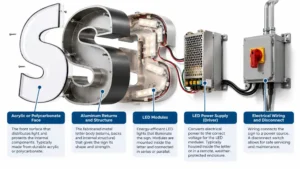
When a quote says “warranty included,” it rarely means one warranty. A commercial sign is a stack of components, and each one tends to carry its own coverage period and its own fine print.
Finish and faces cover paint, vinyl, and acrylic or polycarbonate faces against peeling, cracking and fading beyond normal weathering. “Normal weathering” is the phrase to read twice. Every sign fades a little in Texas sun, and the warranty language decides how much fading counts as a defect.
Fabrication and structure cover welds, cabinets, letter returns, mounting hardware and, on monument and pylon signs, the structure itself. This is often the longest coverage on the quote, since a properly engineered structure rarely fails.
Electrical components include LED modules, power supplies (the drivers that convert building power to the low voltage the LEDs run on), photocells, timers and wiring. These parts often carry a warranty from the component manufacturer that is separate from the sign company’s own. The manufacturer warrants the part. It does not pay for the truck and technician to swap it.
Installation and workmanship covers whether the sign was mounted, sealed and wired correctly. Leaks at wall penetrations and loose mounting usually fall here.
| Component | Ask for in writing |
| Faces and finish | Length of coverage and what the company considers excessive fading, peeling or cracking |
| Structure and fabrication | Length of coverage on welds, cabinets, returns and mounting hardware |
| LED modules and power supplies | Manufacturer warranty term, brand and model, and who handles the claim |
| Installation | Coverage for leaks, loose mounting and wiring faults, and when it starts |
| Labor | Whether technician time, lift or bucket truck and trip charges are included |
Ask the sign company to list each of these separately on the quote with a time period next to it. That lets you compare two bids line by line instead of comparing two copies of the same word.
Why North Texas Weather Changes the Warranty Conversation
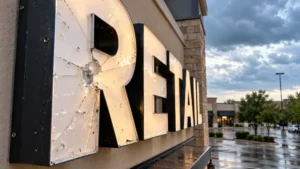
Texas logged 902 major hail events (hailstones one inch or larger) in 2025, the most of any state and more than double second-place Kansas, according to NOAA Storm Prediction Center data compiled by the Insurance Information Institute. Add triple-digit summer heat, strong UV and spring wind, and an outdoor sign in Dallas, Collin or Grayson County works a lot harder than the same sign would in a mild climate.
Most warranties split that weather into two categories. Gradual wear from sun and heat falls under the finish warranty and its weathering language. Sudden damage from hail, wind or a falling limb is usually excluded as an act of nature, which makes it a property insurance question rather than a warranty question.
So ask the sign company two things before install: how its finish warranty defines excessive fading or peeling, and whether it will provide photos and a written repair estimate if you need to file a storm claim. Then call your insurance agent. Many commercial property policies handle outdoor signs as their own category with their own limits, and a freestanding monument sign may be treated differently from letters mounted on the building.
Material choice moves the needle too. A sign built with the right substrate and a quality primer and paint system holds up far better to UV and moisture, which is why we spend a whole guide on the coating system and substrate choice for outdoor signs.
8 Questions to Ask Your Sign Company Before the Install
1. Does the warranty cover labor and lift time, or only parts?
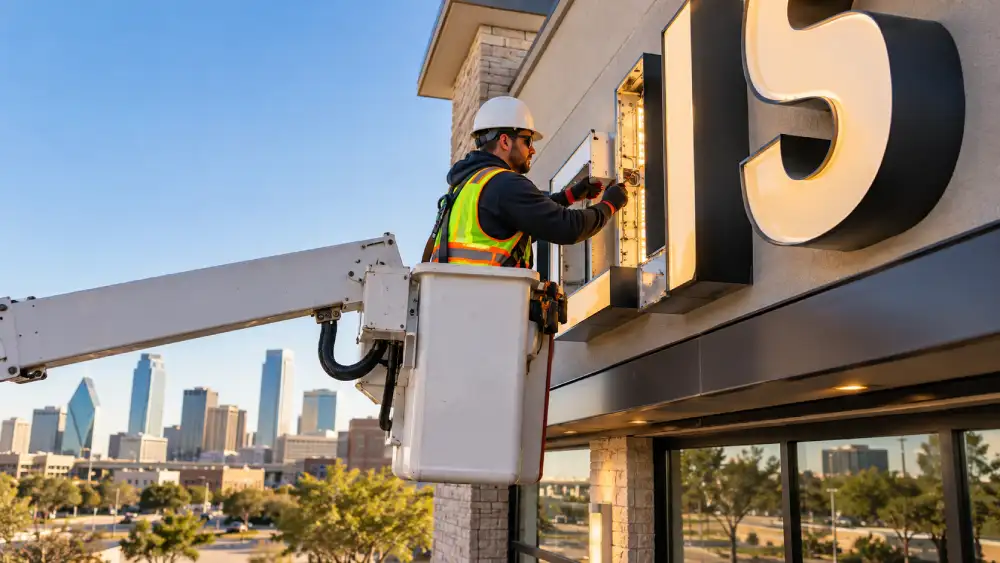
This is the question that separates a useful warranty from a paper one. Replacing a failed power supply on a fascia sign twenty feet up can mean a bucket truck, a licensed sign electrician and a couple of hours on site. If the warranty covers only the part, the part may be the cheapest line on the invoice. Ask whether labor, lift equipment and trip charges are included during the warranty period, and get the answer on the quote.
2. When does the warranty clock start?
Some warranties start on the invoice date, some at shipment and some at installation. If a landlord approval or a city permit review pushes your install back two months, a warranty that started at fabrication has already burned two months before the sign is lit. Ask for the start date to be tied to completed installation and final inspection.
3. Which parts carry a manufacturer warranty, and who files the claim?
LED modules and power supplies often carry the component maker’s own warranty. That coverage only helps if someone diagnoses the failure, files the claim, waits for the part and installs it. Ask whether the sign company handles manufacturer claims for you or hands you a phone number. Ask for the brand and model of the LEDs and power supplies as well, because matching replacement parts is much easier when that information is in your file instead of inside the sign.
4. What voids the warranty?
Common exclusions include repairs or modifications by another company, power surges or problems with the building’s electrical supply, impact damage, harsh cleaning products or pressure washing, and relocating the sign. Ask for the full list. If your building electrician or facilities team plans to work on the sign circuit, find out first whether that ends your coverage.
5. Who services the sign, and are they licensed in Texas?
Texas law requires a license for electrical work, and the Texas Department of Licensing and Regulation (TDLR) issues sign-specific licenses, including the Electrical Sign Contractor license for businesses and master and journeyman sign electrician licenses for individuals. Ask whether service calls are handled by the company’s own crew or subcontracted, then check the license number in TDLR’s online license search. A company that subcontracts every service call can be slower to respond and harder to hold to its warranty.
6. How fast do you respond to a service call?
A dark storefront sign costs you visibility every night it stays off. Ask what response time looks like during the warranty period, how you request service, and whether the company stocks common parts like power supplies. A realistic answer is worth more than a same-day promise that will not survive the week after a big storm, when every sign company in the Metroplex has a full schedule.
7. Does the warranty transfer if you sell, move or renovate?
Businesses sell, leases end and landlords redo facades. Ask whether the warranty transfers to a new owner and what happens if the sign has to come down and go back up during a renovation. Reinstalling a sign can trigger a new permit (our guide to Texas sign permit problems explains why that matters), and a reinstall by a different company may end the original coverage.
8. What maintenance do you recommend, and do you offer a plan?
A warranty covers defects. Neglect is on you. Ask for a written maintenance schedule for your specific sign: how often to clean the faces and with what, when the electrical components should be inspected, and what a service visit includes. If the company offers an annual inspection or maintenance agreement, ask what it covers and whether it changes your warranty terms. At Vantage Point, we also service existing signs, including electrical troubleshooting, LED retrofits, face replacements and structural repairs, so the company that installs your sign can keep maintaining it.
Who Handles Maintenance: You, Your Landlord or the Sign Company?
In a leased space, the warranty answers only part of the question. Your lease and the landlord’s sign criteria usually decide who keeps the sign lit, who pays for repairs and what the fascia has to look like when you move out. Leases often make tenants responsible for their own building sign, including removal and patching the wall at the end of the term. Read your landlord’s sign criteria package with maintenance in mind, not only design rules.
Multi-tenant monument and pylon signs add another layer. The landlord usually owns the structure, while each tenant pays for its own panel and sometimes a share of upkeep through common area charges. If your panel cracks or the cabinet lighting fails, you need to know who calls the sign company and who gets the bill. Our guide to monument signs for commercial property covers that owner and tenant split in more detail.
Put the answer in the project paperwork: the tenant maintains the panel and building letters, the landlord maintains the shared structure, the sign company warrants its work for a stated period. When three parties each assume someone else is handling it, a dark sign can stay dark for months.
A Simple Maintenance Routine for Commercial Signs

Most commercial signs need less attention than owners expect, but they do need some. A basic routine for a North Texas business looks like this:
| When | What to check |
| Monthly, after dark | Dark letters or sections, flickering, and a timer or photocell switching the sign on at the wrong time |
| Spring and after any major storm | Cracked or dented faces, loose letters or panels, water inside cabinets, and damage around the base of monument signs |
| Late summer | Fading, peeling vinyl or paint, and faces warped by heat |
| Once a year (licensed technician) | Electrical connections, power supplies, seals at wall penetrations, mounting hardware and structural anchors |
Cleaning is simple but easy to get wrong. Use mild soap, water and a soft cloth on acrylic and polycarbonate faces. Skip ammonia-based glass cleaners, solvents and pressure washers, which can haze or crack plastic faces and may void the finish warranty.
Leave anything inside an illuminated sign to a licensed sign electrician. The National Electrical Code (Article 600) requires a disconnect for electric signs so the power can be shut off safely during service, and the work behind that disconnect is licensed work in Texas.
Sign type also shapes the long-term maintenance bill. With channel letters, a failed letter can usually be repaired by itself, while a cabinet sign often has to be opened as a whole unit. We compare channel letters vs cabinet signs, including repair costs over time, if you are still weighing the two.
What to Get in Writing Before Install Day
Before you approve the order, make sure your quote or contract includes:
- Warranty terms for each component, with the length of coverage and the start date
- Whether labor, lift equipment and trip charges are covered during the warranty
- The exclusions list, including weather, surges and third-party repairs
- Brand and model of the LED modules and power supplies
- The service contact, expected response time and the TDLR license number of whoever does electrical work
- A recommended maintenance schedule and cleaning instructions
- Who maintains the sign under your lease
On install day, take date-stamped photos of the sign in daylight and after dark, with close-ups of the faces, returns and mounting points. If you file a warranty or insurance claim later, those photos show the condition the sign started in. If you are earlier in the process, our guide to choosing the right exterior sign for a new location walks through sign types, lighting and permits before you get to this stage.