
Key Takeaways
- Many business signs can be written off in full in the year they go up, thanks to Section 179, instead of being depreciated over several years.
- For tax years beginning in 2026, the Section 179 limit is $2,560,000, and it starts shrinking once your qualifying purchases for the year pass $4,090,000 (IRS Publication 946).
- The date that counts is when the sign is installed and ready to use. Signing the quote or paying a deposit in December is not enough.
- Permits, landlord approvals and fabrication take time, so a sign you want working by December 31 needs to be ordered well before the holidays. Confirm the tax side with your CPA.
Every year, somewhere around mid-November, the calls start sounding the same. A business owner has a good year behind them, their accountant mentions equipment purchases, and suddenly the new monument sign they have been putting off since spring becomes urgent. The question is always some version of this: can we get it done before the end of the year?
The short answer on taxes: yes, most business signs can qualify for the Section 179 deduction, which lets you deduct the full cost of qualifying equipment in the year it is placed in service. The catch is the timeline. The deduction depends on when the sign is installed and working, not when you pay for it, and in North Texas the steps between “let’s do it” and “it’s on the wall” take longer than most people expect.
This guide covers how Section 179 applies to signage, which signs are simple and which deserve a closer look, and how to plan backward from December 31 so your project actually lands in this tax year.
A quick note before we start: we build signs, we are not tax advisors. This article explains how the rules generally work so you can have a better conversation with your CPA. Your accountant should make the final call on how your sign is classified and deducted.
What Section 179 Means for a Business Sign Purchase
Section 179 is a part of the federal tax code that lets a business deduct the cost of qualifying equipment and other tangible property in the year it is placed in service, instead of spreading that cost over the asset’s useful life. Without it, a sign is normally depreciated over several years, so you recover the cost slowly.
Here is a simple illustration. Say you invest $40,000 in new exterior signage. Under regular depreciation, you might deduct a portion of that this year and the rest over the following years. If the sign qualifies for Section 179 and you elect it, you may be able to deduct the full $40,000 on this year’s return. Same sign, same cost, very different effect on this year’s taxes.
A few limits apply. For tax years beginning in 2026, the maximum Section 179 deduction is $2,560,000, and it is reduced dollar for dollar once the total cost of qualifying property you place in service that year passes $4,090,000 (source: IRS Publication 946 and Rev. Proc. 2025-32). For most of our clients, those ceilings are far above what they spend on signs. The limit that matters more often is that the deduction cannot exceed your taxable business income for the year, although unused amounts can generally be carried forward.
There is also bonus depreciation, a separate provision that lets businesses deduct a percentage of an asset’s cost in the first year. The One Big Beautiful Bill Act made 100% bonus depreciation permanent for qualified property acquired after January 19, 2025 (IRS Notice 2026-11). That matters for signs because it can cover property that does not fit neatly under Section 179, which we get into below.
One local detail: Texas has no personal income tax, so for most owners this is a federal conversation. If your business pays the Texas franchise tax, ask your CPA how the deduction interacts with it.
Which Signs Typically Qualify (and Which Need a Second Look)

Section 179 is built for tangible personal property used in your business. Many signs fit that description without much debate. Others are attached to land or buildings in ways that can change how they are classified. This is where a short conversation with your accountant pays for itself.
| Sign type | How it is usually discussed | What to ask your CPA |
| Channel letters and cabinet signs mounted on your building | Commonly treated as business equipment eligible for Section 179 | Confirm the classification and recovery period for your industry |
| Dimensional letters, lobby signs and interior wall graphics | Usually treated as personal property used in the business | Whether installation and design costs are included in the basis |
| ADA and wayfinding signs | Often purchased as part of a build-out | Whether they are part of a tenant improvement package or a separate asset |
| Monument and pylon signs with concrete foundations | May be classified as land improvements instead of equipment | If Section 179 does not apply, whether bonus depreciation does |
| Vehicle graphics and fleet wraps | Often treated as an advertising expense rather than equipment | Whether to expense it directly or capitalize it with the vehicle |
The monument and pylon row is the one we see cause confusion. A freestanding sign set on a permanent foundation can be treated as a land improvement, and land improvements generally do not qualify for Section 179. That does not mean the tax benefit disappears. Land improvements usually have a 15-year recovery period, which is short enough to qualify for bonus depreciation. So the path to a first-year deduction may simply be different. If you are budgeting for a new monument sign or a pylon sign, bring this up with your accountant early instead of assuming.
Vehicle graphics are the other outlier. Because a wrap is essentially advertising applied to a vehicle, many accountants treat it as a deductible advertising expense in the year you pay for it. That can be just as useful as Section 179, it just runs through a different line of your return. If you are adding vehicles to your fleet this year, our vehicle graphics and fleet wraps team can match the new units to the ones already on the road.
“Placed in Service” Is the Date That Counts
This is the part that trips people up every December. Placed in service means the asset is ready and available for its intended use. For a sign, that generally means it is fabricated, installed and doing its job. A signed contract, a paid deposit or a sign sitting finished in our shop on December 31 does not get you the deduction for that year.
For lighted signs there is an extra wrinkle. An exterior sign may need its electrical connection made and, depending on the city, a final inspection before it can legally be turned on. Whether a sign that is mounted but not yet energized counts as placed in service is a question for your CPA, so plan for full completion before the deadline, not just installation.
Our practical advice: keep documentation of the completion date. A dated completion sign-off, the final invoice and a photo of the installed sign make your accountant’s job easier and give you a clear record if anyone asks later.
Working Backward From December 31: A North Texas Sign Timeline
The tax deadline is fixed. Everything else has to fit in front of it. Here is how a typical exterior sign project moves, and where the time usually goes.
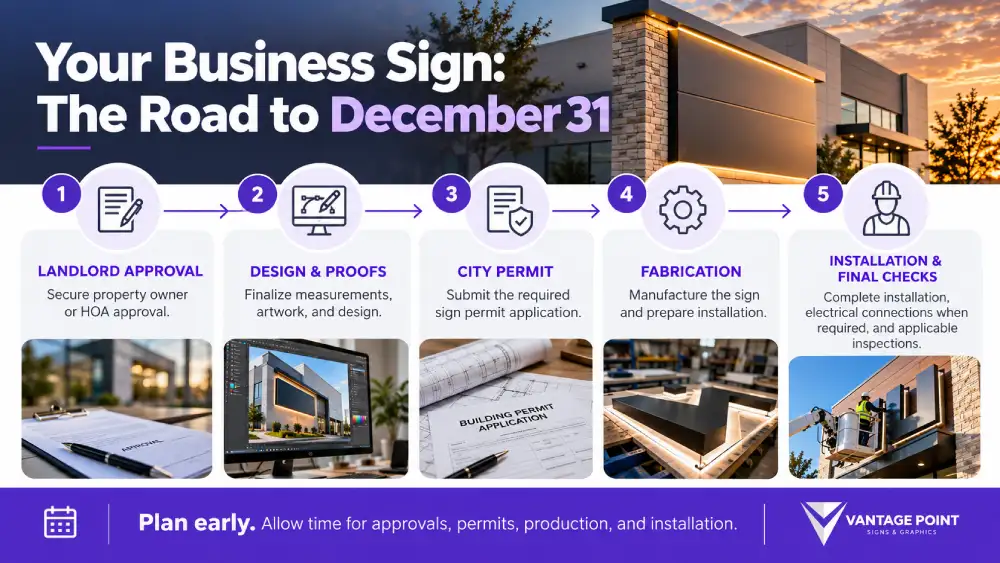
- Landlord or HOA approval. If you lease your space, your landlord’s sign criteria decides size, colors, mounting and sometimes even the fabricator. Approval can take longer than design. Our guide on how to read a sign criteria package from your landlord explains what to look for.
- Design and proofs. Measurements, drawings and a round or two of revisions. This goes faster when you already have brand files and know what you want.
- City permit. Most exterior signs in North Texas need a permit, and review times vary by city and by how busy the planning department is. We walk through one city’s process in the sign permit process in McKinney, TX. Skipping this step is not an option worth considering; here is what happens when you install a sign without a permit in Texas.
- Fabrication. Production time depends on the sign type, materials and the shop’s queue. Year-end is one of the busiest periods for sign shops, which is exactly why waiting costs you.
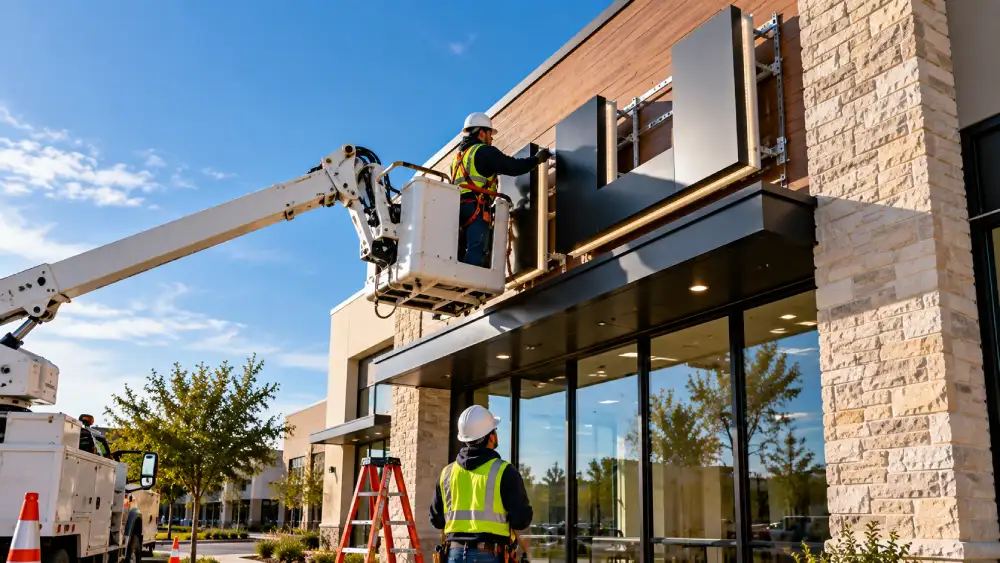
- Installation and final steps. Install crews, lift equipment, electrical connections and any final inspection. Weather can push an install day, and city offices close around Thanksgiving and the last week of December.
Put those together and you can see the problem with starting in December. Interior signs, lobby signs and dimensional letters often skip the city permit and can move quickly. A new pylon with a foundation, engineering and a permit is a much tighter fit for a year-end deadline. When you call a sign company in the fall, ask them directly: “If we approve the design this week, what install date can you commit to?” Then add some margin for approvals you do not control.
Signs Worth Prioritizing Before Year-End
If you are trying to decide what to tackle before December 31, these are the projects that tend to make sense, both for the business and for the calendar.
- Replacing an aging exterior sign. Faded faces, burned-out sections or an old cabinet that no longer matches your brand. A new exterior sign is the most visible upgrade you can make, and it works for you every day after it goes up.
- Interior branding and lobby signage. Usually no city permit, faster production and an immediate effect on how clients see your space.
- Wayfinding and ADA signs for a build-out. If you moved or expanded this year, finishing the interior signage package before the year closes keeps those costs in the same tax year as the rest of the project.
- Fleet graphics for new vehicles. Vehicles purchased this year that are still unbranded are an easy win, since wraps and lettering do not depend on a city permit.
If a monument or pylon sign is on your list but the timeline is tight, it can still make sense to start design and permitting now so the project is ready to install early next year. You lose the current-year timing, but you avoid the January rush and you have a head start on approvals.
What to Bring to Your CPA (and to Us)
A little organization up front saves a lot of back and forth in March. Ask your sign company for an itemized invoice that separates fabrication, installation, permit fees and any electrical work, since your accountant may treat some of those differently. Keep the completion date in writing. And if the sign is part of a larger build-out, let your CPA know so they can decide whether it belongs with the tenant improvements or stands on its own.
On our side, the most useful thing you can tell us is your deadline. If the goal is a sign that is up and running before December 31, say so at the first meeting. It changes how we schedule design, permits and install crews.
Frequently Asked Questions
Are business signs tax deductible?
In most cases, yes. Business signs are typically either deducted in full in the first year through Section 179 or bonus depreciation, or depreciated over several years. How your specific sign is classified depends on what it is and how it is installed, so confirm it with your CPA.
Can I take Section 179 on a sign I paid for but haven’t installed yet?
Generally, no. Section 179 applies in the year the property is placed in service, which for a sign means installed and ready to use. A deposit or full payment in December does not move the deduction into that year if the sign goes up in January.
What is the Section 179 limit for 2026?
For tax years beginning in 2026, the maximum Section 179 deduction is $2,560,000. It is reduced dollar for dollar once the total cost of qualifying property placed in service during the year exceeds $4,090,000, according to IRS Publication 946.
Is a monument sign Section 179 property?
It depends on how it is classified. A freestanding monument sign on a permanent foundation may be treated as a land improvement, which generally does not qualify for Section 179. Land improvements can still qualify for bonus depreciation, so there may be a first-year deduction available through a different route.
Does a vehicle wrap qualify for Section 179?
Vehicle wraps are often treated as an advertising expense rather than equipment, which means they may be deductible in the year you pay for them without using Section 179 at all. Your accountant can tell you which treatment fits your situation.
Planning a Sign Before the Year Closes?
If you want a new sign working before December 31, the best time to start is now, while there is still room in the schedule for approvals and permits. Tell us about your project and your deadline, and we will give you a realistic install date before you commit. If you are still deciding what kind of sign fits your location, our guide on choosing the right exterior sign for a new business location in North Texas is a good place to start.