
Most offices and stores in North Texas have at least one wall doing nothing. It’s painted the landlord’s standard beige, it faces the front door, and every visitor looks at it. Wall graphics turn that surface into part of your brand: printed vinyl, murals, logo walls and frosted glass films that tell people whose space they’re in before anyone says hello.
If you’re researching wall graphics for office branding in Dallas, here’s the short answer. Pick the two or three walls people see first, choose a film that suits the wall’s texture and your lease, and schedule the install after the paint has cured and before the furniture arrives. The rest of this guide covers how that plays out in an office versus a retail space, plus the building details around Dallas, Plano and Frisco that decide whether a graphic still looks right in year three.
What Counts as a Branded Environment?
A branded environment is a physical space where the walls, glass, floors and signs carry the company’s identity, not just the logo on the door. Wall graphics are usually the largest piece of it: printed or cut vinyl, wallcoverings and murals applied directly to interior walls.
The phrase gets used loosely. Some people hear it and picture a full interior design overhaul. For most of the small and mid-size businesses we work with, it means a short list: an entry or reception wall, one or two culture or product walls, and some branded film on interior glass.
Those pieces sit alongside the rest of your interior signage plan, meaning suite IDs, ADA room signs and directories. They should share the same colors and typefaces so the space reads as one brand instead of a collection of vendors. A quick test we like: cover the logo and ask whether a visitor could still guess whose office they’re standing in. If the answer is no, the walls aren’t doing their share.
Office Wall Graphics: Where They Earn Their Keep
Office graphics have two audiences. Clients see the space a few times a year; employees see the same walls every working day. Those two groups want different things from a wall, so it helps to plan by area.
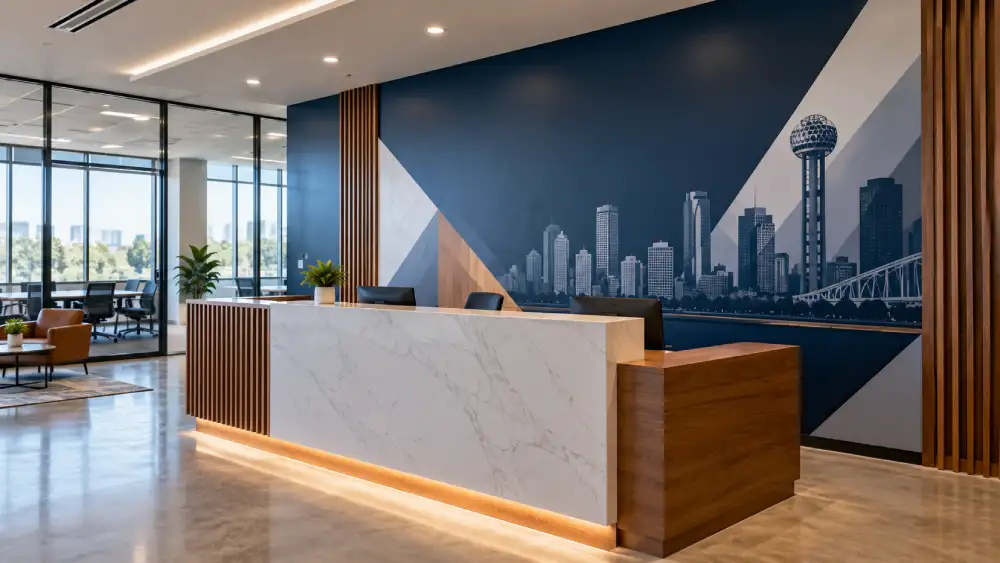
Reception and entry walls. This is the first-impression wall, and it usually pairs a printed background with a dimensional logo. Our guide to what makes a lobby sign work covers the logo itself. The graphic behind it is what makes a 20-foot wall look planned instead of empty.
Corridors and conference rooms. Long hallways are where offices look most generic. A company timeline, large photos of finished projects or imagery of the work you do gives people something to look at on the way to a meeting. Naming conference rooms after local places or landmark jobs, with a graphic to match, is a small detail clients tend to remember.
Breakrooms and team spaces. Mission statements on a wall get mocked when they’re generic. They work when they’re specific: real customer quotes, photos of your crew on actual job sites, milestones the team actually hit.
A reality check on culture walls. Gallup reported that only 31% of U.S. employees were engaged at work in 2024, the lowest level in a decade. A wall graphic won’t fix that, and nobody should sell it as if it will. What it can do is make a return-to-office space feel like it belongs to your company rather than the last tenant, and that’s a fair thing to want from a few hundred square feet of vinyl.
Retail Wall Graphics Work on a Different Clock

Retail walls have a job office walls don’t: they have to sell, and the message changes every few months.
That changes the material. An office logo wall might stay up five years or longer, so it gets a permanent adhesive and a protective laminate. A retail feature wall that rotates for back-to-school, the holidays and a spring launch should be printed on removable film, so the next campaign goes up without patching and repainting.
Placement matters more than size. Put the main graphic on the wall shoppers face as they walk in, usually the back wall, so it pulls them deeper into the store. A photo wall built for social media works best when it’s well lit and has enough floor space in front for someone to step back with a phone. A great graphic squeezed behind a clothing rack does nothing.
Retail interiors also have to agree with the storefront. If the windows are running a holiday promotion and the walls inside still show summer, the store looks neglected. We plan wall and window changes on the same calendar. Our post on window graphics that drive foot traffic covers the glass side of that plan.
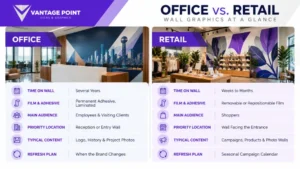
Office vs. Retail Wall Graphics at a Glance
Here’s how the two compare when you’re deciding what to order.
| Office | Retail | |
| Time on the wall | Several years | Weeks to months per campaign |
| Film and adhesive | Permanent adhesive, laminated | Removable or repositionable film |
| Main audience | Employees and visiting clients | Shoppers deciding in seconds |
| First wall to brand | Reception or entry wall | Wall facing the entrance |
| Typical content | Logo, history, values, project photos | Campaigns, products, photo walls |
| Refresh plan | When the brand changes | Built around the seasonal calendar |
The Wall Itself: What North Texas Buildings Throw at Vinyl
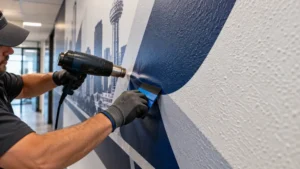
Most articles about wall graphics skip the wall. That’s a mistake, because the surface decides whether the graphic lasts.
Textured drywall. Many commercial suites around Dallas finish drywall with an orange-peel or knockdown texture. Standard vinyl bridges across the bumps instead of bonding into them, and within a few months the edges start to lift. Textured walls call for a film made for rough surfaces, applied with heat so it conforms to the texture, or a printed wallcovering instead of adhesive vinyl. On smooth walls, standard wall films do fine.
Fresh paint. New build-outs are where we see the most trouble. Paint that’s dry to the touch can still be curing, and vinyl applied too early can bubble or refuse to stick. Every film manufacturer publishes a cure window for painted walls, and we schedule the install around that window rather than around the move-in date. Flat finishes and some low-VOC paints are also harder for adhesives to grip, so tell your painter early which walls will get graphics.
Block, brick and concrete. Converted warehouses and older retail buildings, the kind you find in Deep Ellum or downtown McKinney, often have painted block or brick. Vinyl can work there with the right film and heat. Sometimes, though, a print mounted on a panel or a painted mural is the better call, and a good installer will tell you so.
Interior glass. Glass partitions take frosted or printed films that add privacy to conference rooms and carry the brand at the same time. A band of film at eye level also helps people see a glass wall before they walk into it.
Leases, Landlords and Fire Ratings
Two questions should come up before any Dallas-area office or retail install. Both are easy to answer early and expensive to answer late.
What does your lease say? Most commercial leases include language about alterations and about returning the space in its original condition. Permanent graphics on a landlord’s wall can turn into a removal and repainting bill when you move out. Removable films, or graphics printed on panels mounted to the wall, avoid most of that. Read the alterations and restoration sections, and get written approval from the property manager if the lease requires it. If you’re opening a new retail or franchise location, this fits into the same approval process as your exterior sign, which we cover in our post on landlord sign criteria packages.
Does the material need a fire rating? Interior wall finishes in commercial buildings are classified by how fast flame spreads across them, using the ASTM E84 test. Under the International Building Code, which North Texas cities adopt with local amendments, Class A means a flame spread index of 0 to 25, Class B is 26 to 75 and Class C is 76 to 200. The class required depends on the building’s occupancy type and where in the building the finish is installed.
Thickness matters here. The IBC exempts finishes thinner than 0.036 inch that are applied directly to the wall, which covers most standard printed vinyl. Thicker wallcoverings, textile coverings and mounted panels don’t get that pass. If your graphic is anything other than thin vinyl on drywall, ask your installer for the product’s ASTM E84 classification before the fire marshal asks you.
How to Plan a Wall Graphics Project in Dallas Without Rework
This is the order we follow on office and retail projects. Skipping a step is usually how a project ends up reprinted.
- Walk the space as a visitor. Start at the front door and note which walls you see first, from where, and for how long. Those are your priority walls.
- Measure and photograph every wall. Include outlets, light switches, thermostats, door frames and fire alarm devices. Graphics have to work around all of them, and nobody wants a logo split by a thermostat.
- Gather your brand files. Vector logos, exact color values and fonts. A large print shows every flaw in a low-resolution logo pulled off a website.
- Match the film to the wall and the lease. Smooth or textured, fresh or cured paint, permanent or removable. This is where the earlier sections turn into a material spec.
- Approve a scaled proof. A to-scale mockup on a photo of the actual wall catches problems a flat design file hides, like a headline sitting right behind the reception desk.
- Schedule the install around the build-out. After the paint cures and before furniture goes in. In occupied offices and open stores, after-hours installs keep the space working.
If you’d like help with any of these steps, our wall graphics team handles design, material selection and installation in Dallas and across North Texas. Bigger projects that also need room signs and directories should be planned together with your wayfinding system, so both share one design language.
Frequently Asked Questions About Office and Retail Wall Graphics
How much do wall graphics for an office cost?
Cost depends mostly on size, material and wall conditions, so an accurate price needs measurements. A single printed accent wall on smooth drywall sits at the low end, while full murals, textured-wall films, laminates and after-hours installation add to it. Ask for quotes that list film, laminate and installation separately so you can compare them fairly.
Are wall graphics removable without damaging paint?
Removable films are made to come off cleanly from properly cured paint, which is why retailers and tenants on short leases use them. Permanent vinyl can pull paint when it’s removed, especially from flat or freshly painted walls. Tell your installer up front whether the graphic will need to come down later so they can choose the right adhesive.
How long do indoor wall graphics last?
Laminated indoor wall graphics usually last for years, since they aren’t exposed to sun and weather. Wear tends to show first in busy corridors where carts and chairs rub the wall. Retail graphics printed for a single campaign use lighter films and aren’t meant to stay up that long.
Can wall graphics go on textured walls?
Yes, with the right material. Orange-peel and knockdown textures need a film designed for rough surfaces, applied with heat so it presses into the texture, or a printed wallcovering. Standard smooth-wall vinyl on a textured wall tends to lift at the edges within months.
Are wall graphics better than a painted mural?
For most businesses, printed wall graphics are faster to install, easier to update and more exact with logos and brand colors. A hand-painted mural makes sense for a one-of-a-kind art piece, especially on brick or block where vinyl struggles. Plenty of projects use both: a painted mural in a public area and printed graphics for logos and messaging.
Start With the Wall Everyone Sees
You don’t need to brand every surface at once. Pick the wall your clients or customers face when they walk in, get the material right for that wall and your lease, and build from there. When you’re ready to plan it, contact Vantage Point Signs & Graphics for a site visit and a scaled proof of your space. And if you’re still collecting ideas, the Vantage Point blog has more on lobby signs, dimensional letters and wayfinding.