
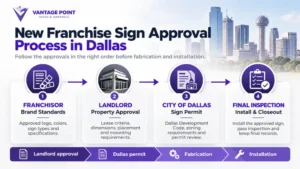
The sign is the last item on most franchise opening checklists and the first one to hold up a grand opening. Franchise signage for a new Dallas location has to clear four checkpoints before it goes on the wall: the franchisor’s brand standards, the landlord’s sign criteria, the City of Dallas permit review, and the final inspection. Coordinating all of that comes down to running the approvals in the right order and working backward from your opening date. This guide walks through each handoff, from collecting sign criteria to install day, so nothing reaches fabrication until it can legally and contractually go on the building.
Key Takeaways
- Gather the franchisor’s sign specs, the landlord’s sign criteria, and the site plan before any design work starts.
- Get landlord approval first, then file the Dallas permit, then fabricate. Reversing that order is the most common cause of rework.
- Confirm power is stubbed to the sign location before the install crew is scheduled.
- Build the schedule backward from your opening date and ask your sign company for current lead times.
What Sign Criteria Means for a Franchise Location
Sign criteria are the written rules that decide what your sign can be: the franchisor’s brand standards, the landlord’s sign criteria in your lease, and the City of Dallas sign regulations. A sign has to satisfy all three, and where they disagree, the most restrictive rule on each point (size, color, illumination, placement) generally controls until someone approves an exception in writing.
Franchisees often have the first one in hand and have not seen the other two. The brand manual tells you the approved logo, colors, letter style and sign types. It does not know that your landlord caps letter height on the fascia, or that the shopping center requires a specific raceway color. That gap is where most new-location sign problems start, and it is why the first job is collecting documents, not commissioning drawings.
Step 1: Collect Every Rule Before Anyone Draws a Sign
Before you ask a sign company for a quote, pull together four things. First, the franchisor’s sign package or brand standards, including any list of approved sign vendors in your franchise agreement. Second, the sign exhibit or criteria attached to your lease, along with the landlord’s contact for sign approvals. Third, a site plan and photos or elevations of the storefront, so the sign can be sized against the real facade. Fourth, your target opening date.
With those in hand, a sign company can tell you quickly where the brand spec and the site rules collide. Our guide to franchise signage brand consistency explains what a criteria package contains and why many franchisors use approved vendor programs, which is worth reading before you request quotes.
Step 2: Match Sign Types to the Site

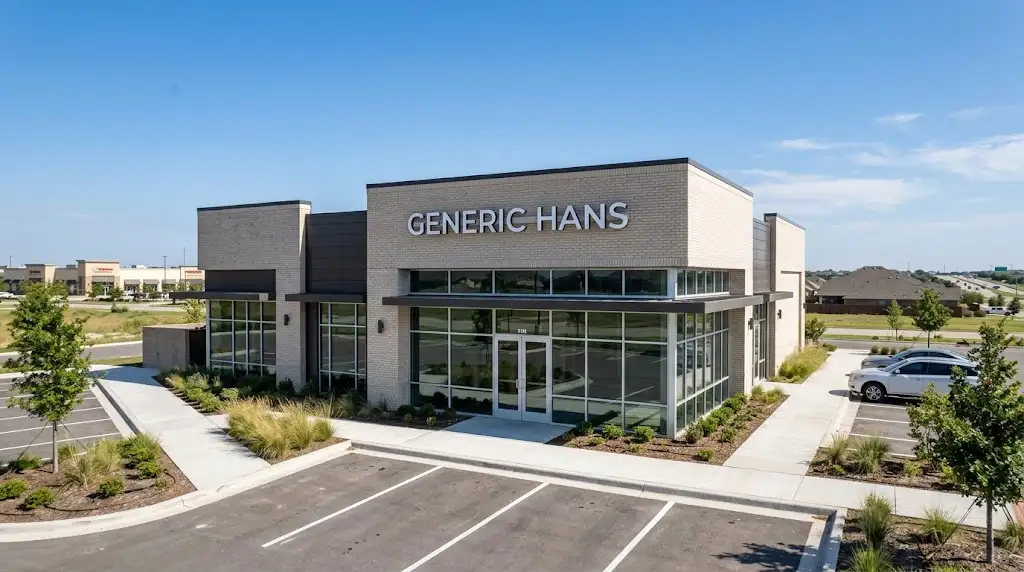
Your franchisor will usually approve a set of sign types, and your building decides which of them actually fit. A standalone pad site might support a pylon sign or monument sign plus building-mounted letters. An inline suite in a shopping center may get a single fascia sign and a tenant panel on a shared monument. A restaurant franchise often adds blade signs and window graphics.
For most franchise storefronts, the core of the package is illuminated channel letters on the building and, where the property allows it, a monument sign at the street. If your franchisor leaves the lit sign style open, our comparison of channel letters vs. cabinet signs covers looks, cost, energy use and permits. The full range of exterior signs for your franchise location is worth scanning before you lock the package, because adding a sign type after permitting means a second permit.
Do not forget the code-driven signs. Accessible room and directional signs inside the space need to meet Texas accessibility standards, and our ADA signs and Braille signage page explains what those requirements cover. In a multi-tenant center, the property may also need a coordinated wayfinding system, which affects where your tenant panel can go.
Step 3: Get Landlord Approval Before the City Sees It
Landlord approval comes before the permit, and the reason is practical. A city permit approves a sign that meets code. It does not approve a sign that meets your lease. If you permit first and the landlord then rejects the color or mounting method, you are revising drawings and refiling.
Send the landlord a complete drawing package: scaled elevations showing the sign on the facade, letter heights, overall dimensions, colors with reference numbers, illumination type, and the mounting method. Ask for approval in writing and keep it with the project file. If your franchisor’s spec exceeds what the landlord allows, raise it now. Franchisors can often approve a variance, but only if someone asks before fabrication. If the lease criteria read like a foreign language, our guide on how to read a landlord’s sign criteria package explains which sections control your sign and which leave room for your brand.
In shared monuments and pylons, confirm which panel position you have been assigned and what the panel dimensions are. Panel sizes are fixed by the structure, so your logo layout has to be built to fit, not the other way around.
Step 4: File the Sign Permit in Dallas
Dallas regulates exterior signs through the Dallas Development Code, and permit applications are submitted through the city’s online DallasNow system. Whether a given sign needs a permit depends on factors like its size, height, illumination, how far it projects, and the zoning district, and some areas carry special sign district or historic rules on top of that. Confirm current thresholds with the City before you finalize drawings. Each city runs its own process, but our McKinney sign permit walkthrough shows what an application and review typically involve. Skipping the step is expensive, as our article on unpermitted signs in Texas explains.
Freestanding signs carry their own set of rules. If your site includes a ground sign, our guide to monument signs for commercial property covers foundation, setback and permit requirements in North Texas, plus who pays for what between owner and tenant. Read it before you commit to a height or illumination plan. Permit drawings also need to match what you eventually build, because the inspector checks the finished sign against the approved set.
This is a good point to decide who files. Many franchise owners hand permitting to the sign company, since the permit package is built from the same shop drawings. Vantage Point’s Dallas sign services include permitting coordination alongside design, fabrication and installation, so the paperwork does not land on the franchisee’s desk in the middle of a build-out.
Step 5: Fabrication and Pre-Install Coordination
Fabrication should not begin until three things are true: the landlord has approved in writing, the permit is issued (or the sign company has confirmed it is not required), and the franchisor has signed off on final artwork. Sending the wrong logo file is a surprisingly common reason for a remake, so confirm you are using the current brand-approved vector artwork.
The step people miss here is power. An illuminated sign needs a circuit run to the sign location, and that work belongs to your electrician or general contractor, not the sign crew. If the circuit is not in place when the sign arrives, the crew can mount the sign but cannot energize it, and you pay for a second visit. Give your contractor the sign’s electrical requirements from the shop drawings early, ideally while the walls are still open.
Material choice affects both price and lifespan, so settle it before fabrication. Our comparison of HDU vs. aluminum sign materials covers cost, durability and Texas heat, which helps you compare quotes on the same components instead of on a bottom-line number alone.
Step 6: Installation, Inspection and Closeout
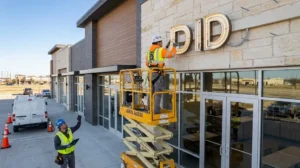
Installation is the last step in a chain, not the first. By the time a crew arrives, the sign has been through survey, approvals, permitting and fabrication, so install day should be the least eventful day of the project. The crew sets up a safe work area, mounts the sign, connects power and cleans up, and the details depend on sign type and mounting height.
After installation, the sign is inspected against the approved permit. Keep the final inspection record, the landlord’s sign-off, and a set of finished photos, since many franchisors ask for photo confirmation of the completed storefront. If you want opening-day window messaging, check landlord and city rules for temporary signs first, then plan your window graphics to go up after the main sign is in place.
Who Owns What: A Back-Scheduling Table
Start from your target opening date and work backward. Each row below must finish before the next one can start, which is why a late document at the top pushes the opening date at the bottom.
| Task | Usual owner | Must be done before |
| Collect brand standards, lease sign criteria, site plan | Franchisee | Design begins |
| Reconcile brand spec with landlord and city rules | Sign company with franchisee | Drawings go to landlord |
| Written landlord approval of sign drawings | Landlord | Permit filing |
| Dallas permit application and approval | Sign company or franchisee | Fabrication |
| Circuit run to sign location | Electrician or general contractor | Install day |
| Fabrication, installation, inspection | Sign company | Opening date |
Common Delays and How to Avoid Them
In our experience, new-location sign delays rarely come from the fabrication shop. They come from sequence errors. The usual ones are approvals obtained out of order, a brand spec that was never checked against the lease, power that was never stubbed to the sign, and a facade that is not ready to receive a sign on the scheduled day.
The fix is a single owner for the sign timeline. Whether that is you, your general contractor or your sign company, one person should hold the landlord approval, the permit, the electrical status and the install date in one place. A short shared checklist beats a long email chain every time.
Franchise Signage in Dallas: Frequently Asked Questions
How long does it take to get a franchise sign installed in Dallas?
It depends on approvals more than fabrication. Landlord review, the city permit and sign production each add time, and they run in sequence. Ask your sign company for current lead times and build your schedule backward from your opening date.
Do I need a permit for a franchise sign in Dallas?
Most exterior commercial signs do, and skipping the permit can lead to fines or a removal order, as covered in our guide to unpermitted signs in Texas. Requirements depend on the sign’s size, height, illumination, projection and zoning district, and permits are filed through the City’s DallasNow system. Confirm the current rules with the City or your sign company before you finalize drawings.
Who pays for franchise signage, the franchisee or the franchisor?
Usually the franchisee, though terms vary by franchise agreement. Some franchisors require specific vendors or supply approved designs. Check your agreement before requesting quotes.
Should I get landlord approval before applying for the sign permit?
Yes. A city permit confirms the sign meets code, not that it meets your lease. Getting written landlord approval first prevents a redesign after the permit is already filed.
Who is responsible for running power to the sign?
Your electrician or general contractor, not the sign crew. Share the sign’s electrical requirements early so the circuit is in place before installation day.
Plan the Sign Before the Build-Out Slips
A new franchise location has plenty of moving parts, and the sign should not be the one that surprises you. Start with the documents, run approvals in order, and confirm power before the crew is booked. If you are opening in Dallas and want a team to handle the coordination, contact Vantage Point Signs to talk through your site and timeline.