Every December, companies across North Texas book hotel ballrooms in Frisco, rent event barns outside McKinney, or clear out their own lobbies for the holiday party. The catering gets ordered in October. The signs get ordered the week before, which is how a well-planned party ends up with a printed sheet of paper taped to the coat check door.
Event signs are the temporary signs that tell guests where to park, where to check in, where to go next and who made the evening possible. Most year-end corporate events need an arrival or parking sign, a welcome sign, directional signs, a branded photo backdrop and table or recognition signs. Order them three to four weeks before the event, and if any of them go outdoors near a street, check your city’s permit rules well before that.
Key takeaways
|
In this guide
|
What counts as event signage?
Event signage is any sign built for a short, fixed period: a single evening, a weekend market, a three-day conference. It differs from permanent signage in two ways that change how you should buy it. The deadline cannot move, and the signs are usually carried, assembled and taken down by people who are not sign installers.
That second point matters more than most planners expect. A sign that looks great in the proof but takes two people and a drill to stand up is a bad event sign. The best event pieces are light, quick to assemble and hard to set up wrong. Before approving any design, ask who will set it up and what they will have in their hands at 5 p.m. on the day of the event.
For a corporate host, event signs have three jobs: getting people in the door, moving them around the venue, and putting the company and its sponsors in front of guests at the right moments. Holiday markets add one more, which is pulling foot traffic in from a sidewalk or parking lot. You can see the full range of options on our event signs and temporary signage page.
The signs a corporate holiday party actually needs
You do not need every sign type on every list you find online. Walk the path a guest takes from their car to the bar, and put a sign wherever they would otherwise stop and ask someone. For most parties, that comes down to the pieces below.
Parking and arrival signs
Guests form an opinion about an event in the parking lot. If your party is at a hotel with shared parking, a venue in a business park, or your own office after hours, put a sign wherever the driver has to make a choice: the lot entrance, the correct garage level, the one door that is actually open. Corrugated plastic yard signs on wire H-stakes work on grass. A-frame sidewalk signs work on pavement and in garages.
The welcome sign
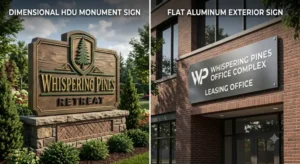
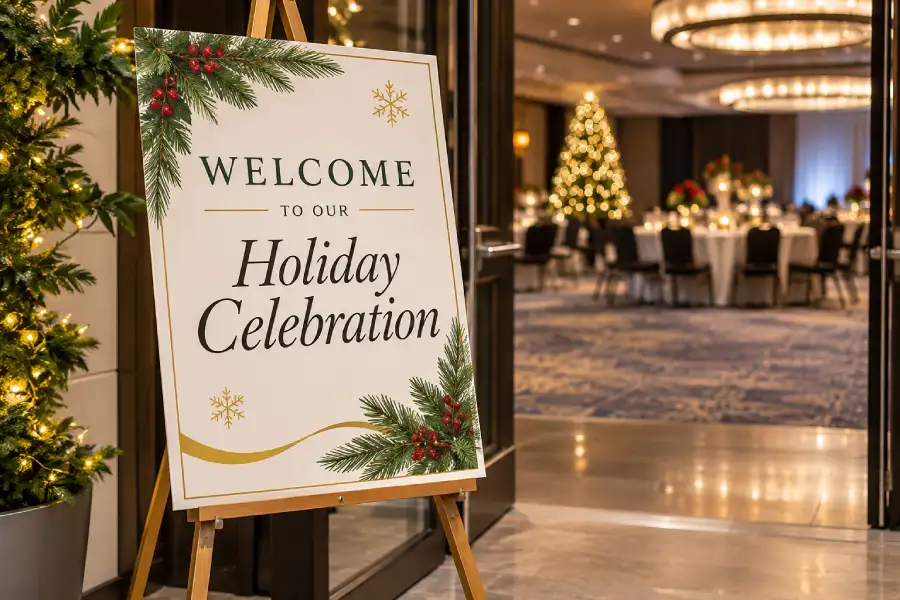
This is the sign that ends up in everyone’s photos, so it is worth spending a little more on. A 24 by 36 inch panel on an easel is the standard for a ballroom entrance. If you want something guests notice from across a hotel lobby, a larger freestanding panel or a retractable banner stand does the job. Keep the text short: company name, event name and possibly the year. If the welcome sign is going in your own office lobby, it should sit near your permanent logo, not cover it, especially if you have dimensional letters on the wall that already do the branding work.
Registration and check-in
If guests check in, sign the table by last name ranges (A to L, M to Z) so the line splits itself. A fitted table throw with your logo makes the check-in area look like part of the event and not a folding table someone pulled from storage.
Directional signs
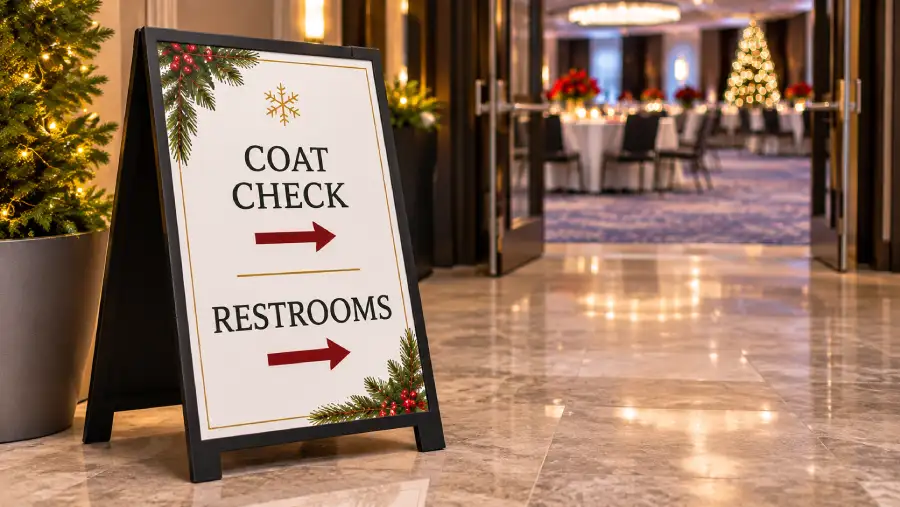
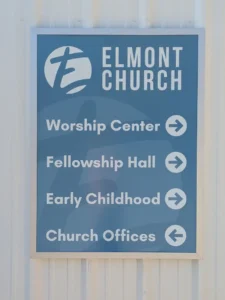
Directional signs answer the questions guests would otherwise ask your staff: restrooms, coat check, the bar, the photo spot, the second room. Use one arrow style and one color across all of them so guests learn the system after the first sign. If the venue has its own permanent signage, place yours where theirs stops, usually at hallway splits and elevator lobbies. The planning logic is the same one we use for permanent directional and wayfinding signs, and our guide to planning wayfinding for a multi-tenant office building walks through how to find those decision points.
Photo backdrop
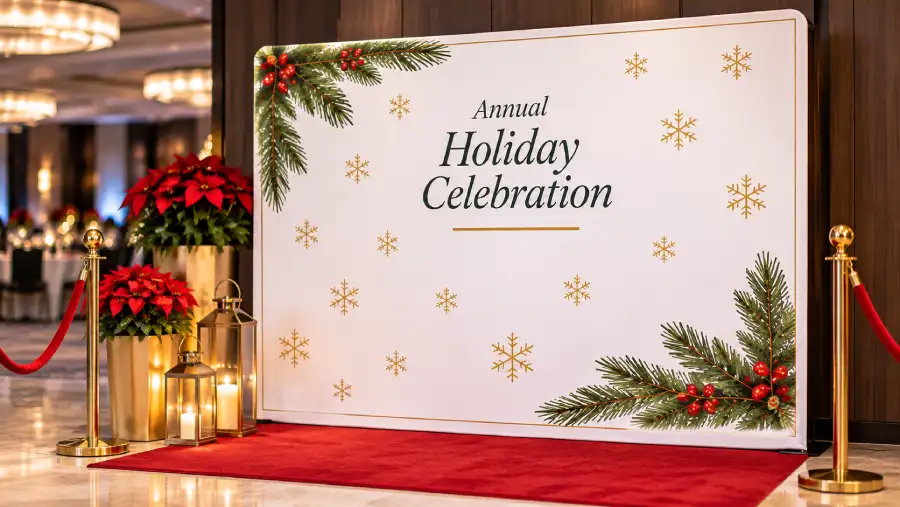
A step-and-repeat is a printed backdrop with a repeating logo pattern, placed behind a spot where people take photos. At an internal party it gives employees a reason to take pictures with your brand in the frame, which turns into free content for your careers page and social channels. Fabric versions on a tension frame pack into a carry bag and do not crease the way vinyl does.
Table, menu and recognition signs
Small acrylic or card table tents carry the menu, the program or the Wi-Fi password. If your year-end event includes awards or a thank-you to donors or top clients, print the recognition board on a rigid panel. People stop and read their own names, and you can hang the board in the office afterward. If the recognition should last longer than one season, custom plaques are built for that.
Holiday markets and outdoor events: what changes outside
Outdoor events in North Texas in late November and December run into two problems indoor events never see.
The first is wind. A retractable banner stand designed for a carpeted ballroom will go over in the first strong gust on an open lot. Outdoors, use stands with water or sand bases, weighted A-frames, and mesh vinyl banners on fences. Mesh lets air pass through the material, so the banner does not act like a sail and pull on its grommets.
The second is darkness. Holiday markets run into the evening, and by late afternoon in December a printed sign with no light on it disappears. Place signs where existing lights reach them, or plan a lit option at the main entrance. Color choice matters more after dark: dark text on a white or yellow background holds up much better at dusk than light text on a dark background.
Weather also swings quickly here. One weekend can bring a warm afternoon and the next a cold rain, so anything going outside should be corrugated plastic, aluminum composite or vinyl. Foam board absorbs moisture and warps, and it should stay indoors.
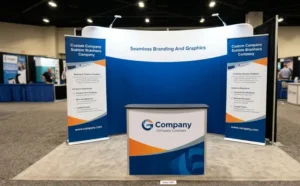
If your business is a vendor at a market and not the host, the job is simpler: a branded booth backdrop, a table throw and one sign that people can read from the aisle. Our article on trade show displays for North Texas businesses covers booth graphics in more detail. Retail shops that want to catch market crowds walking past the store should also look at window graphics, which stay up through the season without anyone setting them up each morning.
When to order event signs: a timeline that works backward
The most common problem with event signs is timing, not design. A permanent sign project can slip a week without much harm. An event sign that arrives the day after the party is worth nothing. This is the schedule we recommend, counted back from the event date:
- 8 or more weeks out: if the event is public and your city requires a special event permit, start the application now. Order large custom pieces, such as an oversized logo display.
- 4 to 6 weeks out: walk the venue. List every point where a guest will need direction, and ask the venue about its rules on tape, stakes, easels and hanging anything from the ceiling.
- 3 to 4 weeks out: send final logos and text, approve proofs and place the order.
- 1 to 2 weeks out: receive the signs, check every name one more time, and do a test assembly of anything with a stand or frame.
- Event day: assign one person to set up signs and one person to take them down.
Late November through mid-December is the busiest stretch of the year for event printing, because most company parties land on the same handful of dates. Ordering a week earlier than you think you need is the cheapest insurance you can buy.
Two details cause most last-minute reprints. The first is names: get executive names, award recipients and sponsor logos approved in writing by whoever owns them. The second is the venue’s delivery rules. Many hotels only accept deliveries at set times or through a specific dock, and a box of signs sitting at the wrong entrance is a box of signs nobody can find.
Do you need a permit for temporary event signs?
For signs inside a venue, usually not. For signs outdoors, especially near a street, often yes, and the answer depends on the city.
McKinney shows how North Texas cities tend to handle it. The city treats a gathering of 75 or more people as a special event when it involves certain activities, one of which is placing temporary signs or banners in or over a public right-of-way, or on private property where the sign ordinance would otherwise prohibit them. Those events need a Special Event Permit, and the application and its $100 fee are due at least 60 days before the event. Tents larger than 400 square feet need their own tent permit. A temporary banner on a business’s own building goes through the regular sign permit process, which asks for a building elevation showing where the banner will hang and a banner detail with dimensions.
Frisco, Plano, Dallas and Sherman each set their own limits on banner size, how long a banner can stay up and where temporary signs can go. Before you order an outdoor banner, call the city’s building or planning office and ask, or ask us to check when you request a quote. Our step-by-step guide to the McKinney sign permit process covers the permanent side, and if a banner is already up without approval, read what happens when you install a sign without a permit in Texas.
Materials: build signs you can use again next year
The material decides where a sign can go, how long it lasts and whether you can pull it out of storage next December. Here is how the common options compare:
| Material | Best for | Indoor or outdoor | Reuse potential |
| Foam board | Easel welcome signs, one-night use | Indoor only | Low, dents and warps |
| Corrugated plastic | Parking and yard signs on stakes | Outdoor | Medium |
| PVC panel | Welcome and recognition boards | Indoor, short outdoor use | High |
| Aluminum composite | Signs you plan to use every year | Both | Very high |
| Vinyl banner | Entrances and stage backdrops | Both | Medium |
| Mesh vinyl banner | Fences and windy outdoor spots | Outdoor | Medium |
| Tension fabric | Step-and-repeat and booth backdrops | Indoor | High, folds into a bag |
The habit that saves the most money is separating what changes from what does not. Print the company name, logo and a general message such as “Happy Holidays from our team” on a durable panel, and put the year and event name on a small replaceable header strip. Next December you reprint the strip, not the sign.
Directional signs work the same way. Print the arrow and the destination (Restrooms, Coat Check, Photo Booth) with no date or theme, store them flat in a labeled box, and use them again at the summer picnic. After the first year, your order shrinks to the pieces that actually changed.
Common mistakes with holiday event signs
Text that is too small. A common rule of thumb is about one inch of letter height for every 10 feet of viewing distance. A directional sign read from 20 feet away needs letters at least two inches tall, and bigger is better.
Too many words. A guest walking past reads four or five words. Put the details on the table tent, not on the welcome sign.
Holiday colors over readability. Red text on a green background looks festive in the proof and nearly disappears in a dim ballroom. Keep the holiday color in the border or background art and the text in high contrast.
Nobody assigned to take signs down. Signs left at the venue are signs you buy again next year. Name one person for teardown before the event, not after.
FAQs about event signs
How far in advance should I order event signs?
Order standard event signs three to four weeks before the event. Allow six weeks or more for large custom pieces or any order placed for the first two weeks of December. If the event needs a city permit, start that process at least 60 days ahead in cities like McKinney.
What signs do I need for a corporate holiday party?
Most corporate holiday parties need a welcome sign, directional signs, check-in signs and a photo backdrop. Add parking or arrival signs if the venue is hard to find, and a recognition board if you are giving awards. Walk the guest path from the parking lot to the bar to find where each one goes.
Do I need a permit for an event banner in North Texas?
It depends on the city and where the banner goes. Banners inside a venue rarely need a permit, while outdoor banners near a street often do. In McKinney, a special event of 75 or more people with temporary signs in the right-of-way needs a Special Event Permit filed at least 60 days before the event.
Can event signs be reused?
Yes, if you plan for it when ordering. Choose durable materials such as aluminum composite, PVC or tension fabric, keep dates off the main panel, and store signs flat. Many businesses reuse directional signs and backdrops for several years.
What is the best material for outdoor event signs?
Corrugated plastic is the usual choice for short-term outdoor signs on stakes. Aluminum composite is better for signs you want to use year after year. For banners on fences or in open, windy areas, mesh vinyl holds up better than solid vinyl.
Planning a year-end event?
If you have an event coming up in Dallas, Plano, Frisco, McKinney, Sherman or Van Alstyne, send us the date, the venue and a rough list of what you think you need. We will tell you what is realistic for your timeline and which pieces are worth making reusable. Browse our event signs and temporary signage options or request a free quote.