Key Takeaways
- A construction site sign does more than say “under construction.” It tells the city who is building, gives brokers and future customers a number to call, and starts marketing the business months before it opens.
- Plan the sign in phases. A post and panel structure installed when you break ground can carry four different messages (project announcement, now leasing, coming soon and grand opening) with panel swaps instead of new posts.
- Size the letters for the road the sign faces. A common rule of thumb is about one inch of letter height for every 10 feet of viewing distance, and a 45 mph road needs more than that.
- Most North Texas cities treat construction signs as temporary signs with size limits and a removal deadline tied to the building permit or certificate of occupancy. Check the local ordinance before you print.
Drive any arterial road between Frisco and Sherman this year and you will pass a dozen dirt pads with a sign out front. Some of those signs are doing real work: they tell drivers what is coming, who is building it, and how to lease space or reserve a spot. Others are a sun-faded rectangle with a phone number nobody answers. The difference usually comes down to planning, not budget.
Construction site signs for a commercial project should identify the project, name the developer and general contractor, give one clear contact for leasing or inquiries, and be built to survive months of wind, mud and mowers. The best ones are also planned in phases, so the same structure carries the project from the first day of site work to grand opening. This guide covers what to put on the sign, how big it needs to be, which materials hold up on a North Texas job site, how city rules affect it, and how to get four messages out of one install.
We build these signs for developers, general contractors and business owners across Collin and Grayson counties, including fast-growing areas like Celina, Prosper and Anna, where a vacant lot can turn into a shopping center in under a year. Most of what follows comes from what we see go right and wrong on those sites.
What Is a Construction Site Sign?
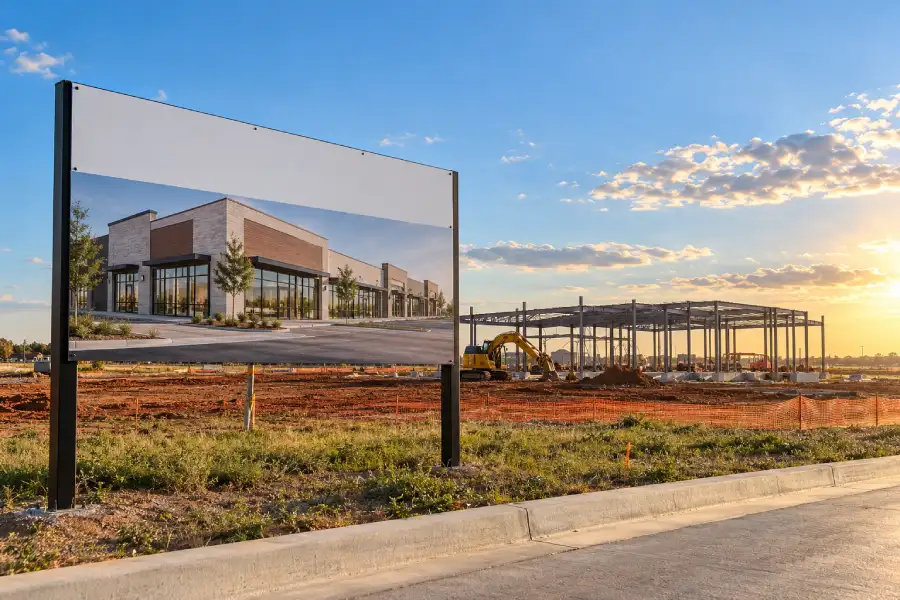
A construction site sign is a temporary, freestanding sign placed at the edge of an active building site to identify the project and the companies involved in it. On commercial work it is usually a post and panel sign: one or two large printed panels mounted between wood or steel posts set in the ground.
People sometimes lump these together with safety signage, but they are different jobs. Safety signs (hard hat areas, no trespassing, traffic control) are required by regulation and face the people on the site. A construction or development sign faces the public. Its job is identification and marketing, and in many cities it is also the sign a code officer looks at when they want to know who is responsible for the property.
On a typical commercial project in North Texas, the construction sign is the first branded thing anyone sees. A restaurant pad, a medical office or a multi-tenant retail center may not have a permanent sign for another eight to twelve months. Until then, the construction sign is the project’s storefront.
What to Put on a Construction Sign (and What to Leave Off)
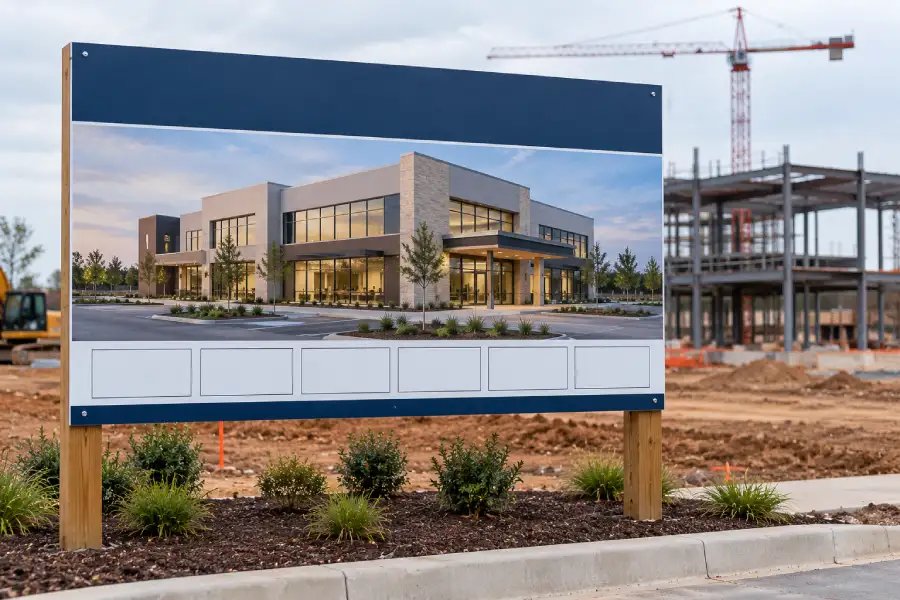
The most common mistake we see is a panel that tries to say everything. A driver gives a roadside sign two or three seconds, so the content has to be ranked. Here is the order we usually recommend:
- Project name or tenant brand. This is the largest element. If the end user is known (“Coming Soon: Dental Office”), lead with that. If it is a spec development, lead with the center’s name.
- What it is. One short line: “Retail and Restaurant Space,” “Medical Office Building,” “Now Leasing.”
- One contact. A phone number or a short web address, not both, and preferably the leasing broker or the business, not the GC’s main office line.
- Project team. Developer, general contractor, architect and lender logos, smaller and grouped along the bottom. These matter to the companies involved and to anyone checking the project, but they are secondary to a passing driver.
- A rendering, if you have a good one. A clean architectural rendering helps a sign stop traffic, but only if it is large enough to read as a building. A tiny rendering squeezed beside six logos becomes a gray smudge from the road.
What to leave off: long URLs, email addresses, square footage tables, and anything that will be outdated in three months. Put the details on a landing page and print a short web address or a QR code that works from the sidewalk, since nobody scans one from a moving car.
Size It for the Road, Not for the Rendering
A construction sign is read from a car, so the road decides the size. A layout that looks balanced on a laptop can be unreadable at 45 mph.
A common rule of thumb in the sign industry is about one inch of letter height for every 10 feet of viewing distance. That gives you legibility, not impact. For a sign that drivers need to notice and read in a few seconds, we usually size the main line larger than the rule suggests, especially on wide roads like US-380, Preston Road or the Dallas North Tollway frontage roads.
In practice, that tends to mean:
- A 4 x 8 foot panel for neighborhood streets, smaller pads and sites where the sign sits close to a slow road.
- An 8 x 8 or 8 x 12 foot panel (often two sheets side by side) for retail and office projects on busy arterials.
- Larger multi-panel structures for big mixed-use developments or highway frontage, where the sign may be read from several hundred feet away.
Before you settle on a size, check what the city allows. Temporary sign sections in local codes often cap sign area and height, and a sign that is too big can delay the project or force a reprint.
Materials and Posts That Survive a North Texas Job Site
fWhat to Put on a Construction Signfwh
A construction sign lives in one of the hardest environments any sign will see. It gets sandblasted by dust and spattered with mud, hit by wind gusts that come through with spring storms, baked in summer sun, and occasionally clipped by a skid steer. The panel material and the posts have to match how long the sign will stand.
Panel materials
- Corrugated plastic (coroplast). Light and inexpensive, fine for short campaigns and small signs. On a large panel in wind it flexes, and in Texas sun the print fades faster. We rarely recommend it for a project that will run longer than a few months.
- Aluminum composite material (ACM). Two thin aluminum skins bonded to a plastic core. It stays flat, takes high quality direct printing, and handles heat well. This is our default for commercial construction signs that will stand six months or more, and the panels can often be reprinted or overlaid for the next phase.
- MDO plywood. Medium density overlay plywood is rigid and affordable for very large panels. It is heavier, needs proper edge sealing, and can swell if water gets into the edges, so it works best for shorter projects or when the budget is tight on a big sign.
Posts and installation
Most construction signs go up on 4×4 or 6×6 treated wood posts, or on square steel tube for larger panels and longer projects. The posts matter more than people think. In our experience, the most common failure on a North Texas construction sign is not a faded print, it is a sign leaning or flat on the ground after a storm because the posts were too light or not set deep enough for the panel size.
A few things we check before install:
- Wind load. Big panels act like sails. Larger signs need more posts, deeper holes and sometimes concrete footings instead of tamped soil.
- Utilities. Call 811 before digging. Commercial sites often have new utility lines going in right where the sign wants to go.
- Placement. Keep it out of the right of way and out of the sight triangle at driveways and intersections, where it can block a driver’s view and draw a code complaint.
- Site traffic. Set the sign where equipment and delivery trucks will not need to turn, and where mowing crews can work around it.
One Structure, Four Messages: Plan the Sign in Phases
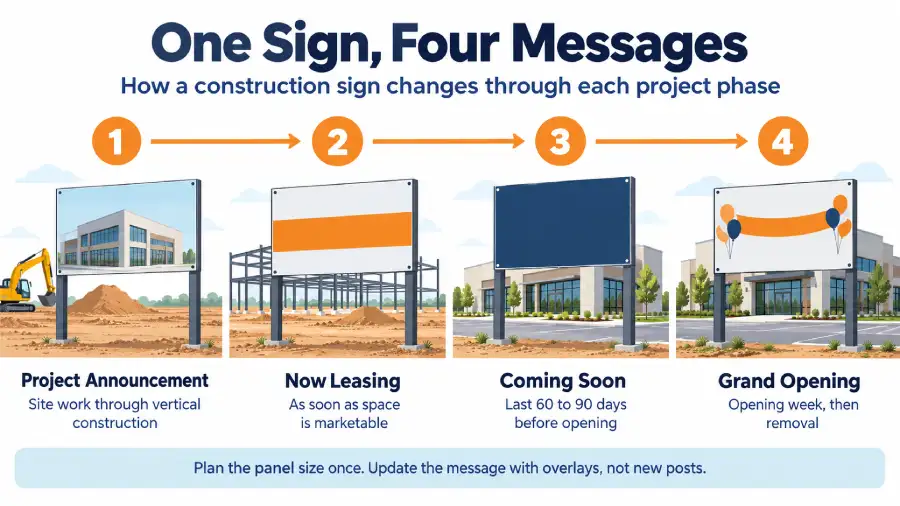
This is the part most projects skip, and it is where a little planning saves real money. A commercial project moves through stages, and the message on the sign should change with it. If you plan the structure at the start, you can update the message by swapping or overlaying panels instead of pulling posts and starting over.
Here is how a typical phased plan looks on a retail or office project:
Here is how a typical phased plan looks on a retail or office project:
| Phase | Typical timing | Main message | What changes on the panel |
|---|---|---|---|
| 1. Project announcement | Site work through vertical construction | Project name, rendering, development team | Full panel with rendering and team logos |
| 2. Now leasing / pre-sales | As soon as space is marketable | “Now Leasing,” available space, broker contact | Overlay or new panel with leasing info |
| 3. Coming soon / now hiring | Last 60 to 90 days before opening | Tenant brand, opening season, hiring info | Tenant-branded panel or overlay |
| 4. Grand opening | Opening week through the permanent sign install | “Now Open,” grand opening date | Short-term banner or overlay, then removal |
Two details make this work. First, design the original panel size so it is easy to reprint (standard sheet sizes keep costs down). Second, leave room in the layout for an overlay strip, the narrow panel that says “Now Leasing” or “Coming Spring 2027,” so a small update does not require a whole new sign.
The last phase is where construction signage meets permanent signage. While the construction sign announces the opening, the permanent monument sign or building sign should already be in permitting. If it is not, the business opens with a temporary sign and a gap in visibility that can last months. For the opening itself, grand opening and event signage such as banners and directional signs can carry the first few weeks.
Permits and Time Limits for Construction Signs in North Texas
Every city writes its own sign code, so there is no single answer for North Texas. What we see across the region, from Dallas to McKinney to Sherman, is a pattern worth knowing before you order:
- Construction signs are usually a temporary sign category. They often have their own size, height and setback limits, separate from permanent signs.
- They are tied to the project. Many cities only allow a construction sign while there is an active building permit, and require it to come down once the certificate of occupancy is issued or the project is complete.
- Some require their own permit, some do not. A few cities let a construction sign go up as part of the building permit. Others want a separate sign permit or registration.
- Private rules can be stricter. Planned developments, HOAs and landlord sign criteria can limit construction signage beyond what the city allows.
The safest approach is to pull the temporary sign section of the local code (or ask us to) before the design is finalized. Putting a sign up without checking can lead to fines and a removal order, which we cover in detail in our guide to what happens when a sign goes up without a permit in Texas. If your project is in McKinney, our walkthrough of the McKinney sign permit process explains how the city reviews sign applications.
Who Orders the Sign and Who Pays for It
On most commercial projects, the developer or property owner orders the main construction sign because it markets the whole property. General contractors sometimes supply a sign with their own branding as part of the job, and on build-to-suit projects the future tenant may want its own “Coming Soon” panel. Leasing brokers often ask for space on the sign too.
When several parties are involved, agree early on whose logos go on the sign, in what order and at what size, and who pays for each phase update. It sounds minor, but a logo dispute is one of the more common reasons a sign order stalls after the design is done.
Common Construction Sign Mistakes
- Ordering the sign last. The sign should go up when you break ground, or before. That is when curiosity is highest and the property is easiest to market.
- Too much text. A panel crowded with logos and details reads as nothing from the road.
- Lightweight posts on a big panel. It is cheaper to set the posts right once than to reinstall after the first storm.
- No plan for the next message. Without a phase plan, every update becomes a new sign.
- Forgetting removal. The sign has to come down on time. Build removal into the order so it does not become a code issue after opening.
Frequently Asked Questions About Construction Site Signs
What should be on a construction site sign?
A construction site sign should show the project name or tenant brand, a short description of what is being built, one contact for leasing or inquiries, and the logos of the developer, general contractor and other key companies. A rendering helps if it is large enough to read from the road. Keep the text short, since drivers only have a few seconds to read it.
How big should a construction sign be?
It depends on the road it faces and what the city allows. A 4 x 8 foot panel works for slower streets and small sites, while busy arterials and highway frontage usually call for 8 x 8 feet or larger. Check the temporary sign limits in the local code before choosing a size.
Do you need a permit for a construction sign in Texas?
Often, yes, but it depends on the city. Texas cities write their own sign ordinances, and many treat construction signs as temporary signs that need a permit or are allowed only while a building permit is active. Your sign company or the city’s planning department can confirm the rules for your site.
How long can a construction sign stay up?
In many North Texas cities, a construction sign can stay up while the project has an active building permit and must come down once the certificate of occupancy is issued or the project is complete. Some cities also set a maximum number of days. The exact limit is in the local sign code.
What is the best material for a construction site sign?
For commercial projects that will last six months or more, aluminum composite material (ACM) on wood or steel posts is the most dependable choice because it stays flat in wind and handles heat. Corrugated plastic works for short campaigns and smaller signs. MDO plywood is an affordable option for very large panels on shorter projects.
Planning a New Commercial Project?
If you are breaking ground in North Texas, the best time to plan the construction sign is before the first equipment shows up. We can help you size it for your road, check the local rules, and set up a phase plan that carries the project through to the permanent sign. Take a look at our custom post and panel signs, or tell us about your project and we will put together a quote. If you are already thinking about the permanent sign, our guide on choosing the right exterior sign for a new business location in North Texas is a good next read, along with our full range of exterior signs.