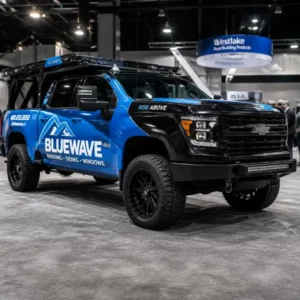

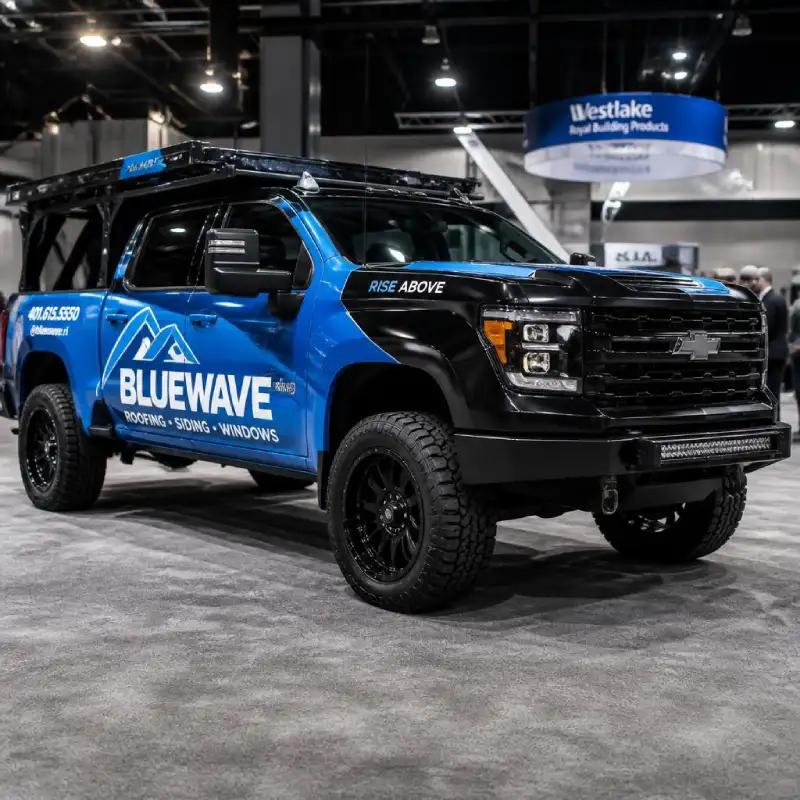
The SEMA Show 2026 runs November 3 through 6 at the Las Vegas Convention Center, and for most automotive businesses the honest math is this: you will spend four days in front of buyers and fifty-one weeks in front of everybody else. That is why vehicle wraps for an automotive business are worth planning around the show rather than after it. A wrap is the one piece of branding that works on the show floor, in the parking lot of the hotel, on the drive home, and every day afterward on the street where your actual customers live.
We fabricate and install signage and vehicle graphics for shops, installers, dealers, and service fleets across North Texas, and the pattern repeats every fall. A shop owner decides in early October that the service van should look sharp for the trip to Las Vegas, calls three sign companies, and finds out that design, proofing, print, and install do not compress into eleven days. The vehicle goes to the show in a half-lettered state or with nothing at all, and the opportunity passes. None of that is a materials problem. It is a calendar problem.
This post covers what actually gets attention at SEMA, the technical difference between show graphics and fleet graphics (they are not the same vinyl and they are not the same job), a realistic production timeline counted backward from opening day, and what to do with the wrap after you fly home. If you run an automotive business in Dallas, Plano, Frisco, McKinney, or Sherman and you are going to Las Vegas this November, this is the part of the trip nobody plans early enough.
What the SEMA Show Floor Actually Rewards
The SEMA Show is not a car show, and that distinction matters for how you brand. It is a trade-only event, closed to the general public, which means the people walking past your vehicle are buying, specifying, or installing. SEMA reported more than 153,000 attendees from 140 countries and regions at the 2025 Show, with more than 2,300 exhibiting brands including 500 first-time exhibitors, and more than 70,000 qualified buyers and decision-makers on the floor.
The buyer behavior is what should shape your graphics. According to SEMA, 83 percent of qualified buyers attend specifically to see new products and 59 percent are actively looking for new vendors. That is an audience scanning for something they have not seen before, moving fast, reading from ten or fifteen feet away. A vehicle covered in six paragraphs of service copy loses to a vehicle with a legible name, a category, and a way to get in touch.
Wraps, films, trim, and graphics live in the Show’s Restyling section, positioned along high-traffic circulation paths and grouped with the customization and styling categories. SEMA also cites more than 20,600 earned media placements and 69.6 billion impressions generated around the Show, which is the part people forget. Photographers shoot vehicles, not booth banners. A clean, well-designed wrap is the most photographable asset you can bring, and it carries your name into coverage you did not pay for.
In our experience, the businesses that get the most out of the trip treat the vehicle as the display and the booth as the supporting cast. That works in reverse too: if the truck in your parking lot back in McKinney looks nothing like the vehicle you brought to Las Vegas, you have two brands instead of one.
Show Graphics and Fleet Graphics Are Two Different Jobs
This is the single most useful thing we can tell an automotive business planning for SEMA, and almost nobody writing about vehicle wraps separates the two.
Show graphics are short-term, high-impact graphics built to look perfect for a specific date and then come off cleanly. Think a feature vehicle, a demo car, a build reveal, or a partner logo wall applied to a trailer. Fleet graphics are long-term identity applied to working vehicles that live outdoors, get washed weekly, sit in Texas sun, and need to look consistent across five or fifteen units for years.
The material choice follows from that. Show graphics can use a lower-tack removable film because the exposure window is measured in weeks and clean removal matters more than five-year durability. Fleet graphics on a curved van body want a cast vinyl with a proper overlaminate, because that is what conforms into rivets and body lines and holds color through summer after summer. Using the wrong one in either direction is expensive: a removable film on a service fleet fails early, and a full cast wrap on a one-weekend show vehicle is money spent on durability you will never use.
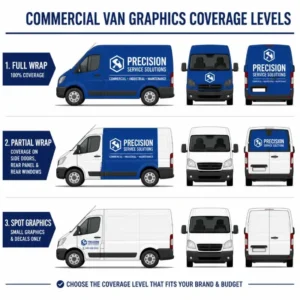
Coverage differs too. Show vehicles frequently get full coverage because the finish is the product. Working fleet vehicles often do better with a partial wrap or heavy spot graphics: doors, rear panel, and a rear-window treatment. It costs less, installs faster, updates cheaply when your phone number or service list changes, and reads just as clearly at a stoplight. We have wrapped plenty of North Texas service fleets where a well-designed partial outperformed the full wrap the owner originally asked for, simply because the design had room to breathe.
If you are sorting out what your own vehicles actually need, our page on vehicle wraps for your automotive business walks through coverage options, materials, and the install process in more detail.
Working Backward From November 3: A Realistic Timeline
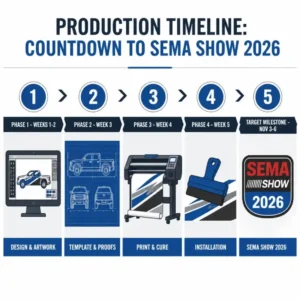
Most wrap disappointment traces back to a compressed schedule, so here is the honest version of how long this takes when it is done properly. Count backward from November 3, 2026.
Weeks 1 to 2 (design and artwork): Vector logo files, brand colors with actual values, and a decision about what the vehicle needs to say. This is where projects stall, usually because the only logo anyone can find is a low-resolution JPG pulled off the website. Sorting out real artwork takes days, not hours.
Week 3 (template, proof, and revisions): Graphics are laid out on a vehicle-specific template so you can see where door handles, seams, and body lines fall. Expect one or two rounds of revisions. Owners almost always want to shrink the copy after seeing the first proof, and they are almost always right.
Week 4 (print, laminate, and cure): Printing is the fast part. Laminating and letting the print outgas before install is not, and skipping it is how you get bubbles two weeks later.
Week 5 (install): A partial wrap on a single van is typically a one-day install. A full wrap runs two to three days depending on the body. Multiply that across a fleet and add scheduling around your vehicles actually being available, which is the constraint owners underestimate most.
That puts a comfortable start date in late September for a single vehicle and early September for anything involving more than two. If you are reading this closer to the Show than that, the realistic move is to scope down rather than rush: door graphics and a rear-window treatment executed well beat a full wrap installed in a hurry. Vinyl does not care about your travel dates, and a rushed install shows.
Display Vehicles, Trailers, and the Graphics That Travel
If you are exhibiting rather than attending, the vehicle is rarely the only thing carrying your name. SEMA maintains specific rules and requirements for vehicles displayed on the Show floor, including vehicles positioned outside a booth footprint, so confirm the current exhibitor guidelines before you commit to a display concept that depends on placement.
Practically speaking, three surfaces do most of the work. The vehicle itself is the anchor. The trailer that hauled it is a second billboard that most exhibitors waste entirely, and trailer graphics are among the cheapest square-footage branding available because the surface is flat and uninterrupted. Booth graphics tie the two together so a buyer who photographs the vehicle in the aisle can still connect it to the company when they scroll back through their phone on the flight home.
The failure mode we see is mismatched color between the vehicle wrap and the printed booth graphics, produced by two different vendors on two different substrates. Brand blue on cast vinyl and brand blue on a fabric tension display will not match unless someone is managing color across both. Running vehicle graphics and trade show displays for North Texas businesses through one shop is less about convenience and more about the two things looking like they belong to the same company.
One more detail worth its weight: put a QR code somewhere on the vehicle and point it at a page built for the person who scanned it. A buyer at SEMA who scans your rear window is not shopping the same way a homeowner is, and dropping them on a generic homepage wastes the only warm lead the wrap generated all week.
The Wrap Earns Its Money After You Fly Home
Four days in Las Vegas is the smallest slice of a wrap’s working life. The vehicle goes back to being a service van, a parts runner, or a shop truck in Collin County traffic, and that is where the return actually accumulates.
The category is growing for a reason. Grand View Research valued the U.S. automotive wrap films market at 1,496.2 million dollars in 2024 and projects it will reach 4,110.0 million dollars by 2030, a compound annual growth rate of 18.8 percent from 2025 to 2030. That is not enthusiasts buying color-change film for weekend cars. A large share of that growth is commercial: businesses working out that a wrapped fleet is advertising they already own the media for.
On effectiveness, we prefer to point at the source rather than repeat the inflated impression counts that circulate in this industry. The Out of Home Advertising Association of America, citing Solomon Partners’ 2023 U.S. Major Media Advertising Effectiveness Analysis, reports that out-of-home advertising produces significantly higher consumer ad recall than live and streaming television, podcasts and radio, print, and online. Vehicle graphics are out-of-home advertising with no media buy attached, which is the whole argument in one sentence.
What that looks like in practice for an automotive business: the van is parked in a customer’s driveway for two hours while you do the work, and every neighbor who walks past reads your name and your phone number. Nobody skipped it, blocked it, or scrolled past it. We have had shop owners in Frisco and Plano tell us the rear-window phone number on a single van generated more inbound calls in a quarter than the paid campaign running alongside it.
What Automotive Businesses in North Texas Get Wrong
Four mistakes account for most of the wraps we end up redoing.
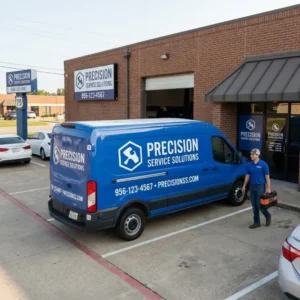
Too much copy. Owners want the wrap to carry the full service list. A wrap has roughly three seconds and fifteen feet to work with. Name, one clear category, phone number, and a short URL. Everything else is decoration that makes the important parts smaller.
Dark backgrounds on white vehicles without a plan. A dark full wrap on a white van looks excellent in the proof and shows every seam, scuff, and adhesive line after eighteen months of Texas sun and gravel. It is doable, but it needs the right film and realistic expectations about wear.
Inconsistency across the fleet. Five vans wrapped by three vendors over four years is five different companies as far as a customer is concerned. This is the same discipline that governs signage consistency across multiple locations (link: /franchise-signage-brand-consistency/), and it applies just as hard to vehicles.
Treating the vehicle as separate from the building. The wrap, the window graphics on your storefront, and the exterior signage at your shop should read as one identity. A customer who saw the van on Highway 75 should recognize your building when they pull in, and right now that is where most automotive businesses in this market lose the thread.
None of these are expensive to avoid. They are all decisions made before anything gets printed, which is exactly why the timeline above matters more than the material spec sheet.
Bringing SEMA Momentum Back to the Shop
The businesses that get real value out of the SEMA Show are the ones whose branding does not stop at the Las Vegas Convention Center doors. You met a distributor on Wednesday, added a product line by January, and now the fleet says something that is no longer true. Plan for that. Build the wrap so the service list lives on a panel that can be replaced without redoing the whole vehicle, and keep the artwork files where you can find them next year.
If the trip to Las Vegas is on your calendar for November 3 through 6, the wrap conversation belongs in September, not the last week of October. We are happy to look at what you have, tell you honestly whether a full wrap or a well-designed partial serves you better, and give you a real production window rather than an optimistic one.
Frequently Asked Questions
Can you wrap your car in business branding?
Yes, and for an automotive business it is usually the highest-return branding you own. Any vehicle you operate can carry your company name, logo, services, and contact information in printed vinyl, from a single owner’s truck to a full service fleet. Commercial vehicle branding is standard practice and legal on personal vehicles you use for business, though you should check your insurance policy, since a wrapped personal vehicle is sometimes reclassified as commercial use.
How much does it cost to wrap a car with branding?
Cost depends on coverage, vehicle size, and body complexity far more than on the graphics themselves. A partial wrap with door graphics and a rear-window treatment sits at the low end, a full wrap on a cargo van or box truck at the high end, and a curved, rivet-heavy body costs more to install than a flat panel van of the same size. The honest answer for any specific vehicle requires knowing the year, make, model, and how much of it you want covered, which is why reputable shops quote per vehicle rather than publishing a flat price.
What is a fleet wrap?
A fleet wrap is vehicle graphics applied consistently across multiple company vehicles so they read as one brand. The design is adapted to each body style rather than copied, so a compact van, a pickup, and a box truck all look like the same company at a glance. Fleet wraps use durable cast vinyl with an overlaminate because the vehicles work outdoors for years, and files are kept on record so vehicles added later match the ones already on the road.
How long do vehicle wraps last on a work vehicle?
A properly installed wrap using quality cast vinyl and an overlaminate generally lasts five to seven years on a working vehicle. Real life shortens that: horizontal surfaces like hoods and roofs take the most sun and fade first, and a vehicle parked outdoors year-round in Texas ages faster than one that lives in a shop bay. Regular hand washing and avoiding harsh pressure washing at close range extend the life meaningfully.
Can anyone go to the SEMA Show?
No. The SEMA Show is a trade-only event and is not open to the general public. Attendees must qualify as members of the automotive aftermarket industry, register, and pay the registration fee. The 2026 Show runs November 3 through 6 at the Las Vegas Convention Center.
Do vehicle wraps for an automotive business need different vinyl than a show car?
Usually yes, and the difference is exposure time. A show or feature vehicle can use a removable, lower-tack film because it only needs to look perfect for a specific event and then come off cleanly. A working fleet vehicle needs cast vinyl with a protective overlaminate to survive years of sun, washing, and road debris. Specifying show-grade film for a service fleet is one of the more common and more expensive mistakes we see.