
Choosing the right exterior sign for a new business location in North Texas comes down to four decisions: sign type, placement, materials, and permitting. Get those four right, and your building communicates your brand to every driver and pedestrian before they ever walk through the door. Get them wrong, and even a well-designed sign becomes invisible or worse, never gets approved. This guide walks North Texas business owners through each decision step by step, with specific guidance on sign types that work in the DFW market, materials built for Texas heat and weather, and the local permitting process most new business owners overlook until it delays their opening date.
Why Exterior Signage Is Your First Marketing Investment
Before a customer searches for you online, they often see your building first. For businesses in high-traffic North Texas corridors, along I-35, Loop 820, Highway 114, or in dense suburban retail strips across Frisco, McKinney, and Arlington a well-placed exterior sign is visible to tens of thousands of vehicles every week. No email campaign, no social media ad, and no Google listing replicates that level of repeated local exposure at that cost.
The International Sign Association estimates that on-premise signage, the physical sign on your building or lot, is the number one driver of new customer discovery for retail and service businesses. For a new location, that effect is even stronger: you have no existing customer base, no word-of-mouth momentum, and no brand recognition in the area. Your exterior sign is doing the job that months of marketing would otherwise need to do.
At Vantage Point Signs, we have worked with new business owners across the DFW metroplex who underestimated their signage timeline and paid for it with a delayed opening or a permit revision that pushed their install back weeks. The decisions below are the ones that matter most, explained the way we walk through them with every new client.
The Main Types of Exterior Signs and When Each One Works
Monument Signs
A monument sign, also called a ground sign, is a low-profile freestanding structure built directly on the ground, typically at a property entrance or along the street frontage. Monument signs excel in suburban retail, office parks, medical campuses, and any location where drivers approach at lower speeds. In the DFW market, they are standard for strip centers, standalone buildings, and multi-tenant business parks. Monument signs can incorporate the center name plus individual tenant panels, making them effective for shared properties. They are permanently installed structures and require a permit from the city in every North Texas municipality we operate in.
Channel Letter Signs
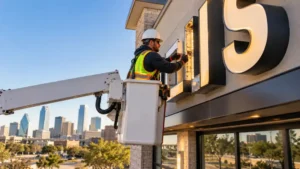
Channel letters are three-dimensional individual letters and logos mounted directly on a building face. Each letter is a hollow metal cabinet, typically aluminum, with an acrylic face that can be illuminated from within using LED modules. For businesses in street-facing retail, this is often the highest-visibility option available. Backlit channel letters are visible day and night, and the dimensional quality makes them stand out against flat, painted signs. For new businesses on competitive retail corridors in Plano, Grapevine, Southlake, or Fort Worth, channel letters are frequently the signage specification required by property management.
Cabinet Signs (Lightbox Signs)
A cabinet sign, sometimes called a lightbox or can sign, is a rectangular aluminum frame with a flat acrylic or polycarbonate face. The graphics are either printed on the face or cut from vinyl. Cabinet signs are a practical, cost-effective option for businesses that need a clean, readable sign with nighttime visibility. They are common in strip centers, franchise locations, and service businesses where a consistent, lit panel is more important than dimensional character.
Pylon Signs and Pole Signs
A pylon sign is a tall freestanding sign mounted on one or two structural poles or a solid base. Pylon signs are built for high-speed road visibility, they are the signs you see towering above gas stations, fast-food locations, and highway-adjacent businesses throughout the DFW metroplex. If your new location sits near a highway on-ramp, a high-traffic arterial road, or a major intersection, a pylon or pole sign may be the only way to capture traffic before it passes. Height restrictions vary by city and zoning district.
Dimensional Letters and Logos
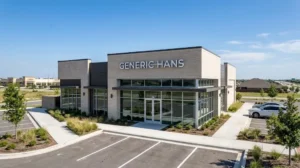
Dimensional letters are fabricated from aluminum, acrylic, or HDU foam and mounted directly on a building wall or sign band. They create a clean, modern look and can be finished in any color, brushed metal, or custom surface treatment. For professional services, medical offices, and upscale retail, dimensional letters communicate a higher level of brand investment than flat vinyl. They can also be paired with LED halo illumination for after-hours visibility without the industrial look of a cabinet sign.
Blade Signs and Projecting Signs
A blade sign, also called a projecting or perpendicular sign, mounts to a building wall and extends outward at a 90-degree angle. Blade signs are designed for pedestrian-first environments: downtown streets, walkable retail districts, and properties where foot traffic approaches from the side rather than head-on. In pedestrian-heavy areas of Denton, McKinney’s historic downtown, or walkable districts in Fort Worth’s Near Southside, blade signs can outperform wall-mounted signage for street-level visibility.
Four Factors That Determine the Right Exterior Sign for Your Location
1. Visibility Distance and Traffic Speed
How far away do you need your sign to be readable and at what speed is traffic passing? A business on a 45-mph suburban arterial needs different signage than one in a slow-speed downtown shopping district. As a general rule: monument signs and pylon signs are engineered for vehicular visibility, while dimensional letters and blade signs perform better for pedestrian-speed environments. Before selecting a sign type, walk or drive your location at different times of day and note where your future customers are coming from and how fast they are moving.
2. Building Type, Lease Terms, and Landlord Requirements
Many commercial leases in North Texas specify a sign package, the approved sign types, sizes, locations, and sometimes even colors for tenant signage. Multi-tenant retail centers managed by national property companies (common throughout Collin, Tarrant, and Denton counties) typically have signage criteria documents that define exactly what is permitted on the building facade. Before investing in any sign design, obtain your landlord’s sign criteria. Vantage Point Signs can review any sign package criteria as part of your initial consultation.
3. Brand Standards and Visual Identity
Your exterior sign is the first physical expression of your brand. Color accuracy, font reproduction, and dimensional execution all affect whether the sign communicates competence and intentionality or not. If you are opening a franchise location, your franchisor has approved sign specifications. If you are launching an independent brand, this is the moment to invest in a sign design that reflects the quality level of your business. Signs that look like shortcuts tend to attract the customers you do not want.
4. Budget and Timeline
Exterior sign projects in North Texas typically take three to eight weeks from design approval to installation, including permit processing time. The permit process alone, which varies significantly between cities in the DFW area, can add two to four weeks depending on the municipality. If you have a hard opening date, work backward from it and contact your sign company earlier than you think you need to. Most timeline problems we see come from customers who started the conversation too late.
The Permitting Process for Exterior Signs in North Texas – What New Businesses Need to Know
Every permanent exterior sign in North Texas monument signs, channel letters, cabinet signs, pylon signs requires a sign permit issued by the city where the business is located. This is true in every DFW municipality: Dallas, Fort Worth, Plano, Frisco, McKinney, Arlington, Irving, Garland, Denton, Lewisville, and every city in between. The permit process exists to verify that your sign meets local size, height, setback, and illumination codes.
The permit application typically requires engineered drawings of the sign, a site plan showing placement, and documentation that the sign meets the city’s sign ordinance. Many new business owners are surprised to learn that their city’s sign code places limits on total sign area, maximum cabinet height, illumination brightness, and even the number of signs allowed per frontage. In some North Texas cities, HOA covenants that govern commercial districts add a second layer of approval beyond the municipal permit.
At Vantage Point Signs, we handle the permit application for every installation we manage. We are familiar with the sign codes across the North Texas municipalities we serve, and we build permit processing time into every project timeline so your sign is installed on schedule. If you are working with a sign vendor who tells you permits “aren’t needed” or “you can handle that yourself,” that should prompt serious questions about their experience with commercial installations.
Materials That Hold Up in North Texas Weather
North Texas weather is demanding on exterior signage. Summer temperatures regularly exceed 100 degrees Fahrenheit, UV exposure bleaches and degrades inferior materials, and severe thunderstorm season brings wind, hail, and driving rain. Material selection is not just a cost decision, it directly affects how long your sign looks professional before it needs refurbishment or replacement.
Aluminum is the standard structural material for most exterior sign applications in this market. It does not rust, holds paint finishes well, and maintains structural integrity in high-wind events. For sign faces, .125-inch aluminum composite material (ACM) provides a flat, rigid surface ideal for digitally printed graphics. Acrylic faces on cabinet signs and channel letters use UV-stable material that resists yellowing; inferior acrylic is one of the most common reasons sign faces look worn within two or three years of installation. Exterior-grade vinyl graphics on aluminum substrates, when laminated with UV-protective overlaminates, hold color for five to seven years under North Texas conditions.
LED illumination has become the standard for all illuminated exterior signs, it consumes 50-70% less energy than fluorescent tube illumination, withstands temperature extremes better, and carries a rated lifespan that typically exceeds the initial lease term for most commercial tenants.
Ready to figure out which exterior sign is right for your new North Texas location? The Vantage Point Signs team works with new businesses across the DFW metroplex from site assessment through permit and installation. Visit our Exterior Signs page to see examples of our commercial work and request a consultation.
Exterior Signs for New Businesses: Your Questions Answered
How long does it take to get an exterior sign installed for a new business?
Most exterior sign projects for new businesses in North Texas take three to eight weeks from design approval to installation. That timeline includes sign fabrication and permit processing, which varies by city; some municipalities review permits in one to two weeks, while others take three to four. If you have a firm opening date, contact your sign company at least six to eight weeks in advance.
Do I need a permit for an exterior sign for my new business in North Texas?
Yes. Every permanent exterior sign in North Texas requires a permit from the city where your business is located. This applies to monument signs, channel letter signs, cabinet signs, and pylon signs. The permit verifies that your sign meets local size, height, setback, and illumination codes. A reputable sign company will handle the permit application as part of your installation project.
What is the most effective type of exterior sign for a new business on a busy road?
For high-traffic vehicular corridors, backlit channel letters or a monument sign at the property entrance tend to deliver the best visibility. Channel letters offer strong building identification readable from a distance, while a monument sign at the street captures traffic before it reaches the parking lot. The right choice depends on your building type, lease terms, and the speed of traffic on your road.
My landlord says I need to follow a “sign package”, what does that mean?
A sign package is a set of criteria from your property management company that defines what exterior signage is allowed for your tenant space. It typically specifies permitted sign types, maximum dimensions, approved mounting locations, illumination rules, and sometimes even color restrictions. You must obtain your landlord’s sign package before designing your sign most commercial leases in North Texas multi-tenant centers include this requirement.
How much does an exterior sign for a new business cost?
Exterior sign costs vary significantly based on sign type, size, materials, and installation complexity. Because every project is different, we do not publish standard pricing instead, we assess each project individually and provide a detailed quote. Contact Vantage Point Signs for a consultation and quote specific to your location and signage goals.